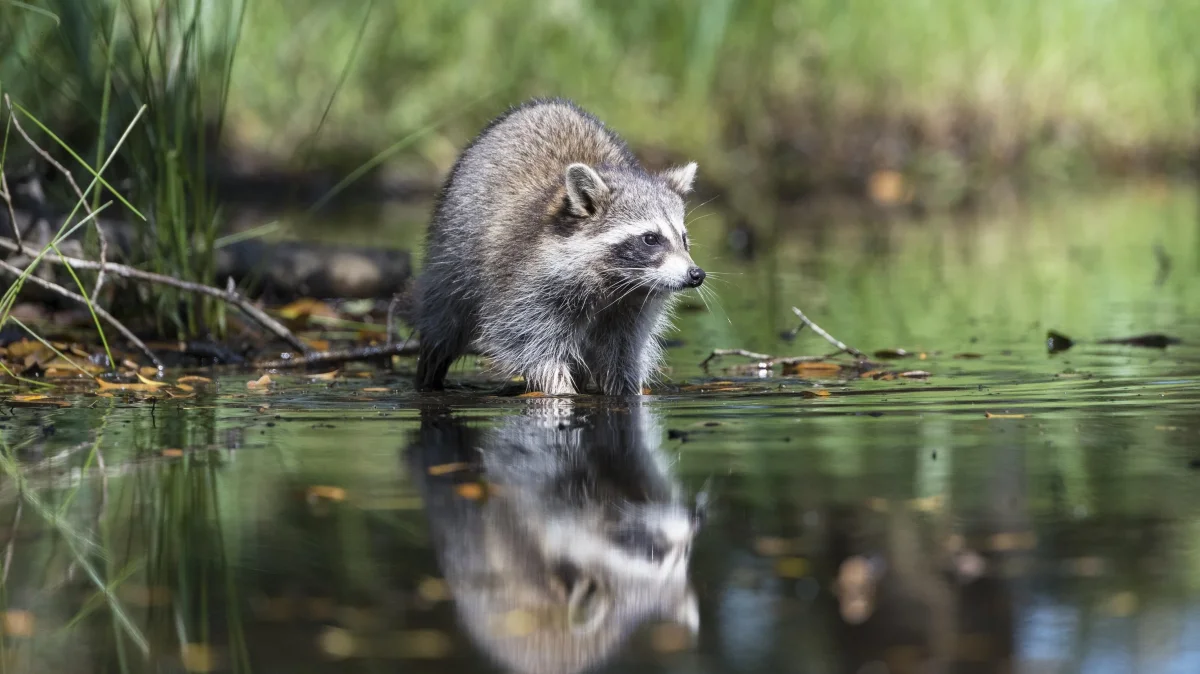
The common raccoon adores doing the laundry. After all, this pursuit helps it avoid starving to death. What kind of little animal is this, and what is the reason for such unusual habits?
How can anyone be so cute!
A raccoon is impossible to mistake for anyone else. An inquisitive little face, huge, astonished button-eyes, and around them what looks like a black mask, resembling a bandit's. Fur of medium length with a dense, warm undercoat, always in perfect order – clean and shiny. The front paws are exactly like human palms, so that it seems the little animal is about to extend one of them to shake your hand.
But the raccoon's main pride is its gorgeous, fluffy striped tail, which it carefully looks after, constantly combing it out, grooming and cherishing it, trying not even to get it wet without an urgent need.

The raccoon is friendly and curious. It is not in the least afraid of humans and may calmly approach their dwelling to poke its inquisitive nose into every corner. And if it finds something tasty – it will, of course, have a treat. Whether it is a plate of food forgotten outside or a trash bin – there is no particular difference for it.
A raccoon is able to snatch food right out of the hands of a child or an inattentive adult. No, it is not a thief. It is simply that everything that falls within its field of vision the raccoon considers its lawful prey.

Why «washer»?
The nimble beast prefers to live by a body of water (a river, lake, or marsh) and spends most of its time in the water. It rummages around, constantly rinsing and sorting through something. This is how it hunts – yes, the small, good-natured raccoon is a real predator. Without looking, it feels along the bottom with its paws, digs up the silt, shifts the pebbles, and finds its prey, after which it thoroughly swishes it around in the water.
Its fingers, which are already supersensitive, become clean and even more receptive, and the little animal can determine blindly whether what it has found is edible. It loves to feast on fish, crayfish, and frogs. It is not at all against lizards, insects, and birds' eggs. And in summer it gladly eats fruits, berries, and nuts.

A raccoon can spend hours studying everything underwater. This love of doing the laundry is so strong that raccoons living in captivity do not lag behind their wild kin. They find discarded objects and, out of curiosity, also drag them off as quickly as possible to rinse in a basin or bucket. A towel, an empty bottle, a TV remote, a toy, and sometimes even its own offspring end up in the water. Such a fondness for «washing» is what gave the common raccoon its name.

Interesting facts about the common raccoon
- The raccoon came to us from North America quite recently – in the first half of the 20th century. Now it is found mostly in warm and comfortable places: Azerbaijan, Kyrgyzstan, and the Caucasus.
- The raccoon's favorite home is tree hollows, but if there are none nearby, it may settle among fallen trunks, stones, or in a pile of brushwood. It will also agree to someone else's burrow, for example a badger's (it does not know how to dig them itself).
- During the day the little animal sleeps in, and in the evening it goes out to hunt.
- In winter it goes into hibernation like a bear, but does not sleep soundly. In a warm climate it does not fall asleep at all.
- It can swim, but does so extremely rarely and reluctantly.
- Thanks to its long claws, it climbs trees superbly. The joints of its hind legs rotate 180 degrees, and the raccoon easily runs along branches head down.
- It is very smart and learns easily. To achieve its goal, it constructs long logical chains, for example: jump up onto the sink – turn the tap – plug the drain – cause a flood – splash around until the owner comes running.

- It will gladly agree to become a domestic pet, just feed it more often. But remember: more than anything in the world, the raccoon loves attention and getting up to mischief, and the word «no» means absolutely nothing to it.
- In a moment of danger it does not lose its head: it falls to the ground and pretends to be dead. If that does not help, it will bravely growl and bite. It is a pity that in the wild it has far too many enemies (including its own curiosity, which drives it to climb where it should not). That is why these little animals usually live no more than 5 years. But in captivity their life can last 20 or even 30 years.