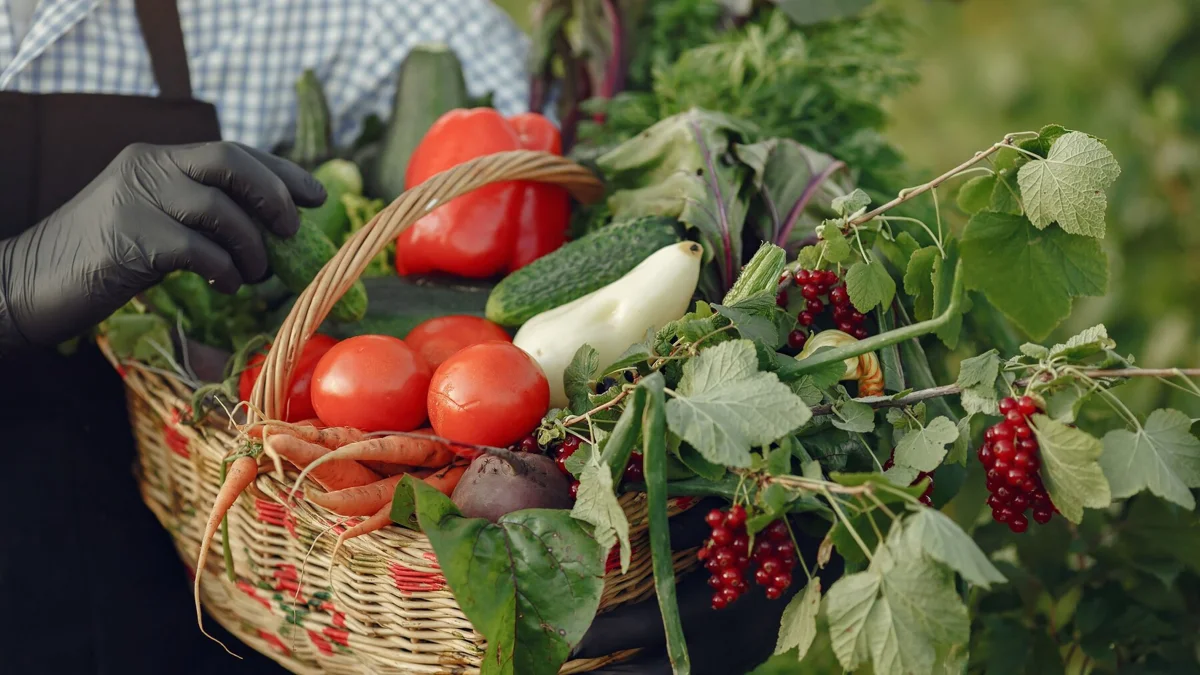
How is potassium beneficial for plants and how do you use it correctly to get a rich and tasty harvest? Read about it in our article.
For large and sweet fruit
Potassium is one of the main building materials, responsible for cell growth and the healthy development of various crops. It improves protein and carbohydrate metabolism, promotes the accumulation of sugar, and speeds up photosynthesis.
Plants overwinter better, become more resistant to diseases, pests, and unfavorable conditions – drought and temperature swings. When such fertilizers are applied properly, the harvest ripens faster, the fruit grows large and sweet, and it stores better.

If a plant lacks potassium, this can lead to:
- Weak flowering or even its complete absence;
- Thin and weak stems;
- The leaves of vegetable crops turn yellow and wrinkle, dry out at the edges, the lower ones die off, while the upper ones remain healthy and green;
- Stunted growth may be observed;
- On fruit trees, by midsummer the leaves change color to a reddish hue, and the fruit ripens unevenly.
An excess of potassium is no better. In this case:
- the leaves become spotted and turn yellow between the veins,
- stunted growth may be observed,
- the tips of the rootlets die off.

Which vegetables and fruits need potassium feeding
Potassium is essential for absolutely all plants. In large quantities it is beneficial for vegetable crops such as potatoes, tomatoes, cucumbers, carrots, cabbage, eggplant, and peppers. Among fruit and berry crops, the apple, pear, plum, cherry, grape, and watermelon need this beneficial element most.
It is required to a lesser extent by grains, radishes, onions, lettuce, gooseberries, strawberries, and currants.
Types of mineral potassium fertilizers
Potassium chloride. This is the fertilizer richest in potassium (from 45 to 62%), but it has a big drawback – the chlorine in its composition is very harmful to plants. For this reason it can only be applied to the soil in autumn, long before sowing, so that over the winter the element has time to be completely washed out by precipitation. It is not recommended for use in acidic soils or as a feed for crops that do not tolerate chlorine: tomatoes, potatoes, peppers.

Potassium salt (contains 50% potassium). Well suited for beets, corn, celery, sunflowers, and carrots. Because of its high chlorine content, it can also only be applied in autumn as a basic fertilizer and on non-acidic soils.
Potassium sulfate (18% sulfur, up to 46% potassium). It contains no chlorine, but does contain calcium and magnesium, which are beneficial for all plants. It is absorbed well and can be used year-round. It is not recommended to mix this fertilizer with lime additives and manure.
Potassium nitrate, or potassium/Indian saltpeter (15% nitrogen and 45% potassium). Used as a root feeding during the fruit-ripening period, as well as at the start of the season. It is especially effective for grapes, tomatoes, and potatoes.

Complex mineral fertilizers, which contain several beneficial elements, work well.
Potassium magnesium sulfate (kalimagnesia) (30% potassium, 17% sulfur, and 10% magnesium). It is considered chlorine-free, despite containing a small percentage of the harmful element. It is applied to planting holes in spring as a basic feed and in autumn during digging, and is better absorbed in acidic soils. It works well on potatoes, sugar beets, ornamental plants, and sunflowers.
Azofoska (16% each of potassium, nitrogen, and phosphorus). Suitable for any crops, throughout the entire season.

Homemade potassium fertilizers
There are excellent natural feeds containing potassium that, in terms of their properties, can fully rival mineral ones.
Wood ash. It also contains phosphorus, calcium, iron, and other elements important for plants. It also acts as an excellent soil loosener. For the fertilizer to be eco-friendly, you must not burn household waste – newspapers, plastic, and the like – together with the wood and plant residues. Young wood contains noticeably more potassium than old wood.
Ash can be used for both root and foliar feeding. Pour 1–2 teaspoons of dry ash into the holes for seedlings, 1 kg under saplings, and a glass per square meter for digging. To prepare a solution, stir a glass of ash into a bucket of water and water the plants at the root. It is not recommended to use wood ash together with organic matter: manure, bird droppings (this leads to nitrogen loss), or to mix it with nitrogen fertilizers and superphosphate.

Compost. A very valuable and budget-friendly feed, gathered from weeds, plant tops, branches, and fallen leaves. Fruit and vegetable peels and eggshells may also be used in the compost pile, and sprinkling each layer with ash speeds up maturation. Compost not only saturates the soil with potassium, phosphorus, nitrogen, and magnesium, but also loosens it, maintains a comfortable moisture level, and improves air circulation. It is perfectly suited for any crops.
It is applied to the soil at a ratio of 15–20 kg per square meter. You can pour it straight into the holes when planting saplings or dig over the beds together with a 5 cm layer of feed. It is best to use compost that is not fresh but has been left to mature for at least a couple of years, especially for cabbage, cucumbers, pumpkin, radishes, and spinach.