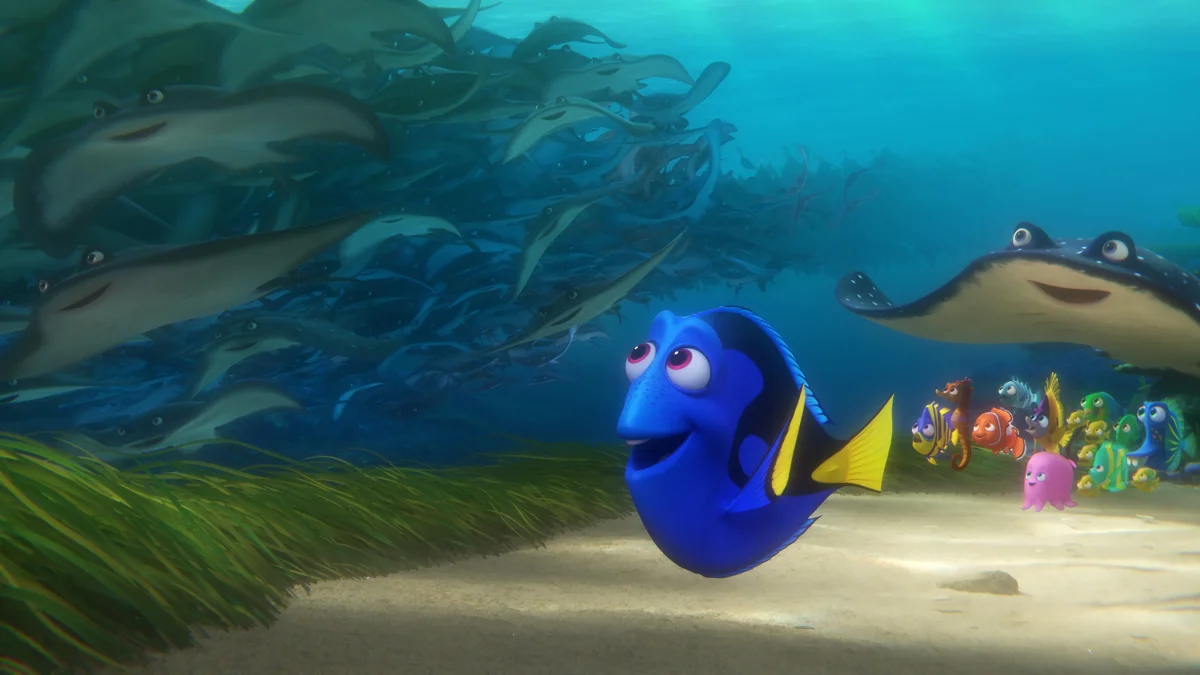
This animated film was released 20 years ago, yet it still remains one of the most beloved among both children and adults.
Both viewers and critics were delighted by the film’s stunning visual effects, its touching story, and its cheerful characters. Many were especially fond of Dory, the little blue fish suffering from memory loss. But what kind of fish is she really?
Dory – is a blue tang (Paracanthurus hepatus). In reality, this fish looks almost like in the cartoon. Its fins are flat and rounded in shape, mostly a bright and rich royal blue color. The body color is also blue, with black and bright-yellow markings. They grow from 25 to 30 cm and usually weigh about 0.4-0.5 kg.

When blue tangs are younger, they are usually much brighter, especially their yellow markings. As the fish mature, they take on deeper shades of blue. When they experience stress, their bodies can take on a more purple coloring. Blue tangs live up to 20 years.
Although in «Finding Nemo» Dory – is a friendly and harmless fish, in life she is not at all like that. Blue tangs in the real world have their own hidden weapon: a peculiar toxin known as ciguatera. This toxin is contained in a pair of venomous spines on either side of the tail. These spines are razor-sharp and can easily cut through human skin.
When a tang is in danger, it raises its sharp spines with venomous tips and strikes with them. The ciguatera toxin usually causes bouts of vomiting and diarrhea in people, along with such unpleasant symptoms as a throbbing headache and body aches. In some people it can even lead to hallucinations and complications with the heart and breathing.

Where do blue tangs live?
Blue tangs live in the warm shallow waters of the Indian and Pacific Oceans. They live among the reefs of Australia, Japan, Indonesia, the Philippines, New Caledonia, Sri Lanka, and East Africa.
They live and travel in schools of 8 to 14 fish. These little fish are omnivores and feed on algae and tiny sea creatures such as plankton. Without these fish the algae would proliferate and smother the corals, which would damage the entire ocean ecosystem.
From their tiny eggs (only about 0.8 millimeters in diameter) hatch blue fry, revealing semi-transparent bodies with silvery bellies and tiny rudimentary spines. These tiny creatures are born without any pigments, mouths, or eyes. At first they are completely helpless, and they do not even have a heartbeat!
For the first few hours of their new life they drift aimlessly along the ocean currents. And within 9-12 months the once tiny blue creatures turn into fully formed adults.

Can a blue tang be kept as a pet?
The answer to this question is complicated. Yes, technically it is possible. Moreover, it is the only Atlantic species that pet stores sell. But blue tangs are not at all happy in captivity and do poorly in aquariums. Since they feed mainly on algae, they cannot survive on ordinary fish food.
In addition, blue tangs are extremely difficult to breed in captivity, and their eggs rarely survive. In fact, 90% of the blue tangs you see in a pet store were caught from their natural home in the ocean.