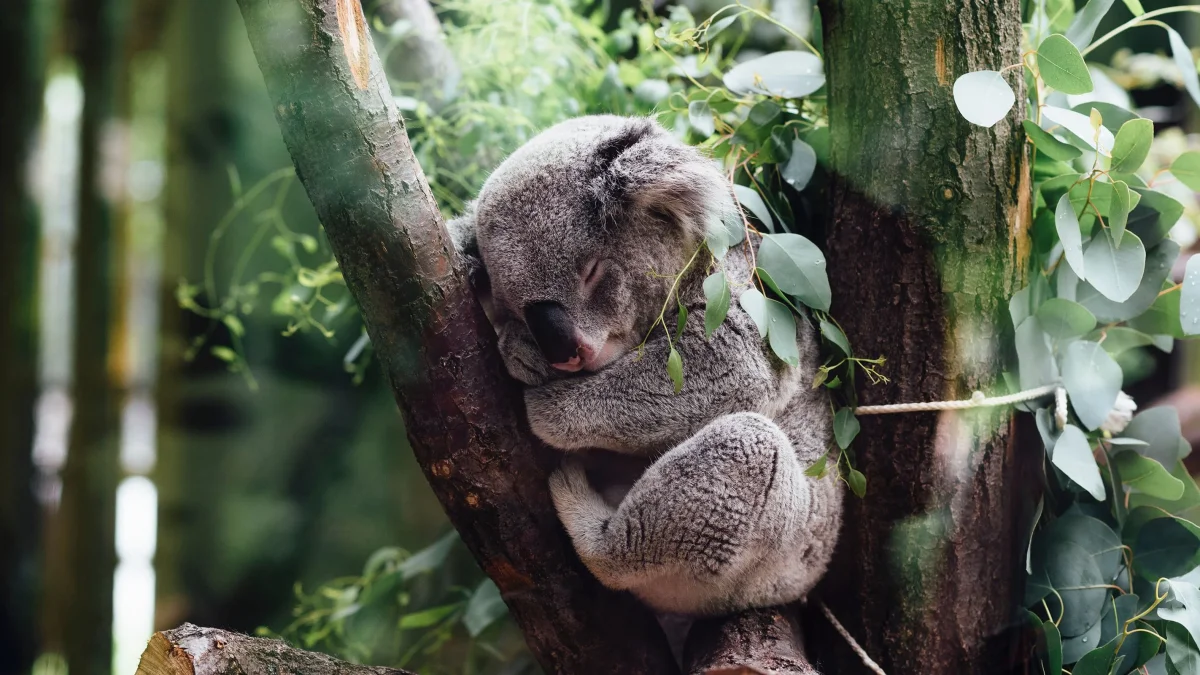
Nature created it exactly this way – it chews, sleeps, and procreates, though not very actively. You look at this adorable little creature and an uneasy feeling comes over you, as if the script of a dystopian film were playing out in the wild. You can't help but wonder – will humans turn into koalas a few centuries from now?
Judge for yourself. The koala has no need to use cleverness to find food. In nature there are no other creatures that want to feed exclusively on eucalyptus leaves, meaning there are no competitors. Imagine that humans, too, no longer needed to worry about where to get money or buy groceries. Delivery brings everything, the smartphone provides entertainment, you just press a button and watch endless videos. Why, in that case, would a person need to develop at all?

And so the koala, living in a constant state of nirvana and experiencing no stress whatsoever, simply has no need to think about anything at all. The koala's brain is almost smooth and takes up just 2 percent of its total body mass, one of the lowest figures among mammals. And yet the koala's brain once filled the entire skull! Now, all this Australian cutie has to do – is chew and sleep.

Dumb and happy
Koalas sleep about 80 percent of their lives. All their energy goes toward digesting eucalyptus leaves, which have little nutritional value. They need at least a kilogram of fresh leaves a day. And if you place a pile of leaves in front of a koala, the animal simply won't understand what to do with them. After all, it knows that food must be plucked from a tree – and no other way.

Nature took care of its creations to a greater or lesser degree, but not of koalas. The poor things, created to chew endlessly, lose their teeth fairly quickly. When they switch from mother's milk to their main food, they almost immediately develop tooth decay, and when no teeth are left in their mouths, they have no choice but to die of hunger.
This is surprising, because in other mammal species – for example, in some rodents like squirrels – the teeth never stop growing throughout their entire lives. Mother Nature turned out to be very cruel to her plump, furry children.

No gentlemen
As for courtship and mating rituals, here too everything is utterly primitive. The male simply pounces on the female regardless of whether she is ready to mate or not. And afterward he is unable to recognize his partner. Moreover, male koalas become very aggressive during the breeding season. Fights are not uncommon, during which they may throw an opponent off a tree, but even here there is no stress. The animal's brain is protected by a kind of helmet of cerebrospinal fluid, so head injuries pose no threat to them.

The young, of which no more than two are born, at first feed on their mother's milk, like all mammals. When the time comes for them to switch to their main food, it suddenly turns out that their bodies lack the enzymes to digest eucalyptus. So they have to feed on their mother's droppings – in this way the digestive system is prepared for adult life.
Koalas live about 12 years, though there are known cases of them reaching 20, but, of course, in captivity and with proper care.
Deadly trustfulness
Another striking manifestation of koalas' stupidity – is their inability to save themselves. In a fire, and fires are not uncommon in eucalyptus groves, our hero will not run anywhere; he will simply cling more tightly to the branches. If no one saves him – the animal will perish.

Because of their thick fur, koalas were subjected to almost mass extermination. In the 1920s nearly 2 million pelts were exported from Australia. The population came under threat and the authorities introduced a ban on hunting these harmless creatures. The trustful koalas did not understand that they faced deadly danger and trustingly walked up to people. Today koala parks have been created in Australia, and there is also a special hospital whose doctors help injured animals.