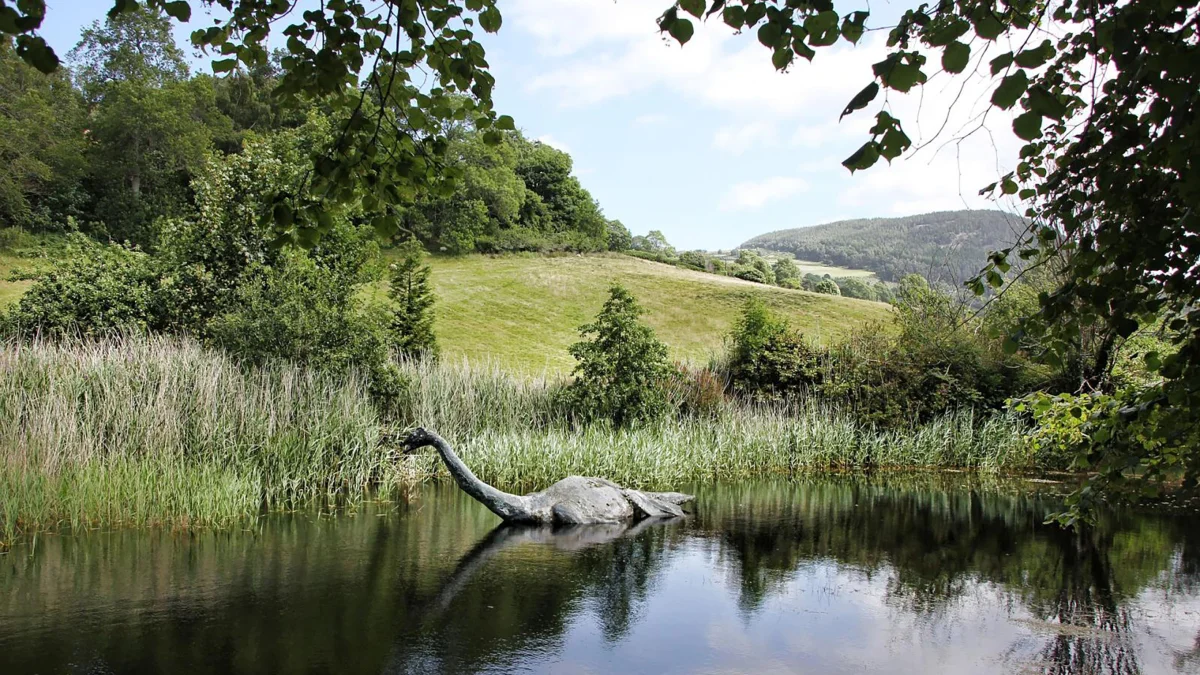
One of the first sightings of Nessie occurred on May 2, 1933. The journalist Alex Campbell, who worked part-time, identified the possible presence of a monster in the lake. A few months later, on August 4, 1933, a certain George Spicer and his wife saw a creature resembling a dragon that waddled across the road. It had an animal in its mouth. Since then, more than 1,000 sightings of the Loch Ness «monster» have been recorded, which has given rise to many theories. Some say that the lake is home to prehistoric treasures, while others think that it is simply a log or the wake of a boat.

Those Who Have Seen the Monster Describe It the Same Way
All the oldest published descriptions of the monster compare it to the dragons of myths and legends. Later ones add more details, for example, that the monster has a long neck and a large body with one or several humps on its back. Since the creature usually stays in the water, its tail and limbs remain out of sight. Nevertheless, rare sightings of the monster on land tend to describe it as a creature with a tail and webbed limbs.
The Most Famous Photograph of the Loch Ness Monster
Robert Wilson, a surgeon from London, took the picture in 1934. He allegedly saw the monster while looking at the lake and managed to take four shots before the monster returned to the water. Of these four photographs, only two showed the neck and part of the back of the monster sticking out of the water.

Photo: Roland Marske/http://imagebroker.com/#/search/
However, the December 1975 issue of the Sunday Telegraph exposed this as a hoax. It turned out that Marmaduke Wetherell had used a toy submarine as a stand-in for the monster and asked his grandson Ian Wetherell to photograph it. Then the insurance agent Maurice Chambers passed the photographs to his friend Wilson, who sold them to the Daily Mail.
Dinsdale's Film – the First Video of the Monster
In 1960 the first video recording was made by aeronautical engineer Tim Dinsdale, who left his job for the sake of searching for the legendary monster. Supposedly, it was the monster's hump sticking out above the water as it swam just below the surface. He filmed it on the last day of a 6-day search for the monster and managed to capture its movements on 12 meters of film.
Experts, however, do not agree that the film serves as proof of the monster's existence. They believe that Dinsdale captured a man in a boat sailing across the lake. Or a log – in short, a more rational explanation can be found for the footage. Cryptozoologists, however, refuse to give up, even claiming that the enhanced details actually show the shadow of the monster's body right beneath the surface of the water.

Anthony Shiels: Trick or Truth?
The magician and psychic Anthony Shiels took distinct photographs of the monster in 1977 while camping near Urquhart Castle in Scotland. He even claimed that he had used his powers to summon Nessie out of the water, which allowed him to photograph it. Experts disagreed with this and even directly called the monster in his photographs the «Loch Ness Doll» for looking so obviously staged.
George Edwards's Fake
Another person who devoted himself to searching for the monster. He took a photo of Nessie in 2011 during one of his daily searches for the monster in the lake. Experts disagreed with the reality of the monster, instead pointing out that the hump in the water that Edwards photographed turned out to be a fiberglass model from a National Geographic channel documentary in which Edwards participated. Later, in 2013, Edwards admitted that yes, he had indeed faked the photograph of the monster.

Sonar Readings from the 1950s Sparked Controversy
In 1954 the sonar from the fishing boat Rival III detected a large object underwater at a depth of 146 meters, moving level with the boat. Cryptozoologists believe that this proves the existence of Nessie, but experts consider it unclear, and other explanations are possible.
Deliberate searches using sonar in the 1960s revealed two strange readings, the first of which they later dismissed, attributing it to a school of fish swimming underwater. The second, however, remains a mystery, since it did not match the readings that fish produced on the sonar. Another sonar from a boat in 2011 detected something resembling the Rival III data at a depth of 23 meters. The readings did not match the data for fish or a seal, but in 2012 scientists confirmed that it was a patch of algae and zooplankton.
The First Organized Searches for the Monster
They were arranged in 1934 by Edward Mountain – the expedition lasted for five weeks, beginning on July 13 of that year. Twenty people with binoculars and cameras combed the area around Loch Ness in search of any traces of the monster. In all, they managed to take 21 photographs, none of which experts find particularly convincing. Supervisor James Fraser remained there until September, when he managed to film the monster. Experts also reject this as proof of the monster's presence, identifying the animal on the film as a seal at a distance.

The Society of Nessie Believers
A special society created to search for the monster did once exist in Britain. They called themselves the Loch Ness Investigation Bureau (LNIB), founded by Norman Collins, Richard Fitter, David James, Peter Scott, and Constance Whyte in 1962. From 1965 to 1972 they maintained a camp by the lake at Achnahannet and regularly sent out observers around the lake. At its peak in 1969, the LNIB numbered more than a thousand members, just over half of whom were from the United Kingdom. In the end the LNIB disbanded in 1972.
Robert Rines Searched for the Monster Since the 1970s
In 1972 he used a combination of sonar and an underwater camera to try to find the monster. In the end he managed to photograph its flipper, but he later admitted that he had retouched the photograph, since the original turned out to be too blurry.
Another search in 1975 led Rines to claim that he had photographed the monster's body and head. Experts disagreed, identifying the supposed body of the monster as a log, and its supposed head – as a stump. In 2001 Rines undertook yet another search, and although he failed to find the monster, he stated that the lake might have a hidden connection to the sea. This time the experts proved most agreeable, based on how Rines found sea mollusks and fungi beneath the lake. The last search in 2018 found nothing interesting at all.

The BBC Television Company Sponsored a Search for the Monster in 2003
They used no fewer than 600 sonar systems for the search, backed by satellite tracking. Experts testified that the BBC's methods allowed them to pick up a small buoy in the middle of the ocean. The search found no trace of the monster, which led the BBC to publicly declare the Loch Ness monster to be nothing more than a myth.
In 2014 Apple Maps Spotted the Monster
That same year, a satellite image on Apple Maps showed something resembling some kind of large animal on the northern side of the lake. Cryptozoologists claimed that this was proof of Nessie's existence, but experts identified the unclear something as the wake of a boat. The boat itself was hidden as a result of the image-stitching by Apple Maps' own program. Other experts considered it a seal creating ripples on the water, or even just floating wood.
In 2018 Scientists Conducted a DNA Study of All Living Things in the Lake
They came from several universities around the world and took random samples from all over the lake, studying the DNA of everything living in it.
The results were made public in 2019, when the scientists found no DNA of any large fish in the lake. They also found no traces of the DNA of a seal, an otter, or a reptile – and yet experts had claimed that in some images it was precisely a seal. Nevertheless, they discovered an unusually large amount of eel DNA in the lake. Perhaps the monster was an unusually large eel?
Some scientists also believe that monster sightings may simply be connected with misidentified animals. Rotting tree trunks floating in the lake could also have given the impression of monsters. Even the supposedly huge splashes could have been the result of an explosion of gases bursting out from the trunk of a rotting tree underwater.

Hoaxes Involving Nessie in the 1930s
The Italian journalist Francesco Gasparini published one of the first news articles about the Loch Ness monster back in 1933. However, in 1959 he admitted that he had made it up only as a pretext for writing a long article that would surely draw a large audience.
Elaborate Hoaxes
In 1972 a group of zoologists from the «Flamingo Park» zoo in Yorkshire set off in search of Nessie. They discovered a body more than 5 meters long and weighing more than a ton floating in the lake. The zoologists claimed that the body was brown, with scales and claw-like flippers, as well as a bear's head. However, the police thwarted the zoologists' attempts to take it away for identification, based on a law that prohibited the removal of the bodies of unknown animals from Loch Ness. Later an investigation revealed that Flamingo Park education department employee John Shields had mutilated an elephant seal before throwing the body into the lake to deceive his colleagues.

Later Versions
In 2003 Gerald McSorley discovered some sort of fossil after accidentally falling into the lake. However, after an investigation, experts found that someone had planted the fossil in the lake to mislead anyone who found it. In 2004 a television crew built a model of a robot dinosaur, which they placed in the lake as part of the filming of a documentary. At least 600 reports of people seeing Nessie came precisely from those who saw this robot.
Nessie – a Plesiosaur?
These speculations by cryptozoologists date back to the 1930s, but experts reject them, since the plesiosaur went extinct along with the other dinosaurs 65 million years ago. They also point out that Loch Ness formed only about 10,000 years ago, so even if plesiosaurs had survived to our day, they would never have reached the lake. There is also the bone structure of the plesiosaur, which never allowed the animal to raise itself out of the water.
Or Maybe an Invertebrate?
Here is yet another strange but true example of facts about the Loch Ness monster. The British journalist F. W. Holiday first put forward this theory in 1968, based on how people in the Middle Ages called dragons worms. According to Holiday, «Nessie» may in fact turn out to be an example of a bristle worm, which explains its appearance both on land and at sea, as well as the strange shape of its back. Experts reject this, considering it even less likely than a dinosaur living in Loch Ness.