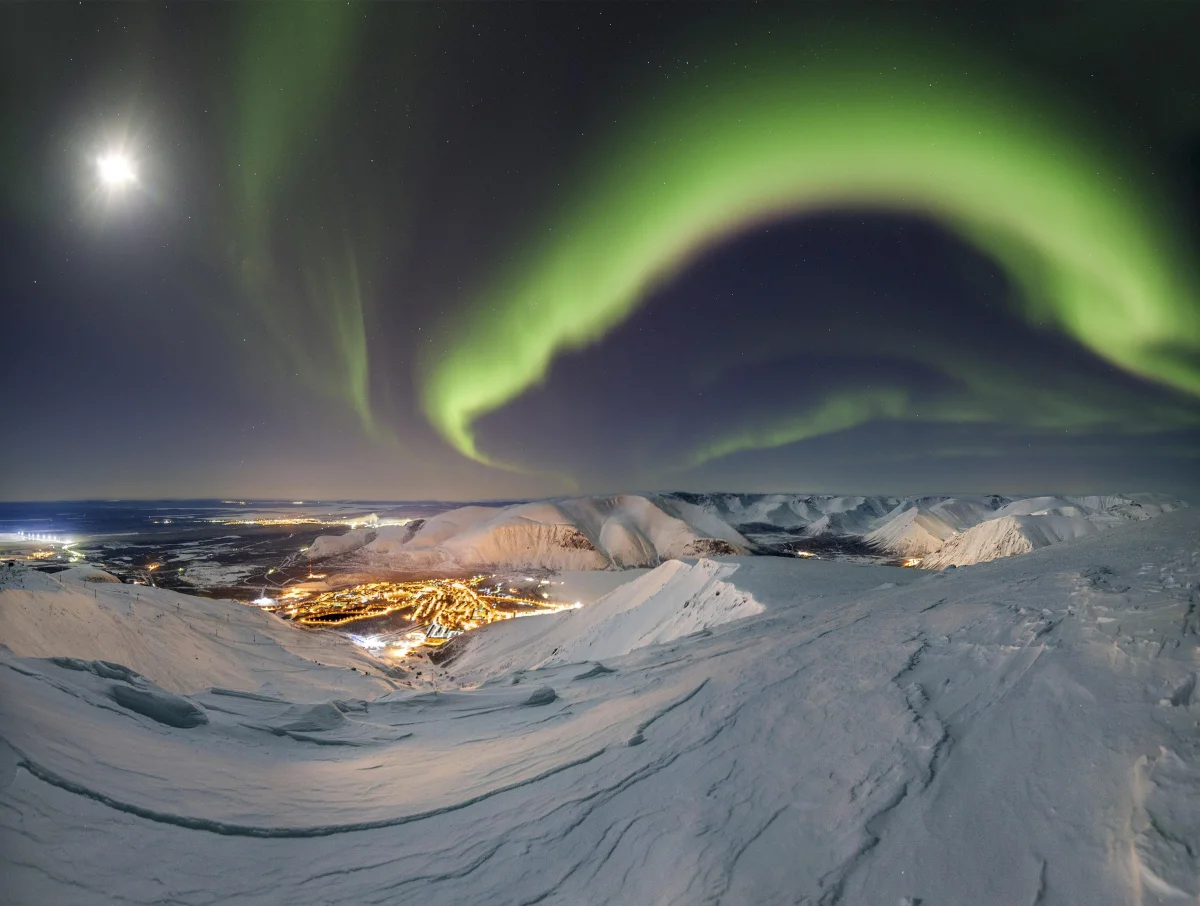
The Khibiny Mountains offer skiing from November through May — seven months, longer than any other ski destination in Russia. But within that season lie four completely different experiences: from a polar night under the northern lights to spring sunbathing on snow in a t-shirt.
The Khibiny aren't the Alps or the Caucasus. These are modest mountains with gentle elevation changes, no fireplace chalets in sight. But this place offers something found nowhere else in European Russia: snow above the Arctic Circle that still sits deep when dandelions are already blooming in Moscow, and daylight that runs two hours in midwinter and twenty in April. Let's break down exactly which month to go, and why.
Where It Is, and How the Climate Works
The ski resorts of the Khibiny — Bolshoy Wudyavr (BigWood) and Kukisvumchorr — sit near the town of Kirovsk, Murmansk Oblast, 200 kilometers above the Arctic Circle. The highest point of the Khibiny massif is Mount Yudychvumchorr, at 1,201 meters. Runs start at elevations of 500–1,000 meters.
The climate is subarctic, but milder than you'd expect at this latitude, thanks to the influence of the Gulf Stream and the Atlantic.
Average winter temperature runs 5 to 14°F (–10 to –15°C), though weeks of –22°F (–30°C) cold do happen. Snow cover sets in by October and persists through late May or early June. By winter's end, snow depth in the mountains reaches 1.5–2 meters.
November–December: Polar Night and the Start of the Season
The season at Bolshoy Wudyavr typically opens in late November, running on artificial snow across several trails. By December, natural snow accumulates enough for the main slopes to open.
From December 2 to January 11, Kirovsk experiences a polar night — the sun never rises above the horizon. Daylight amounts to two or three hours of pink twilight around midday, then darkness returns. The trails are lit, and skiing remains possible, but the experience feels otherworldly: lamps along the slope, stars overhead, and if you're lucky, the northern lights directly overhead mid-run.
Who it suits: anyone chasing a unique atmosphere who isn't bothered by darkness. Crowds are thin, prices lower, no lines at the lifts. The downside: strong winds are possible, occasionally closing the upper cable car lines.
January–February: Maximum Snow and Cold
After the polar night ends, daylight starts growing — slowly, by a few minutes each day. By late January, there's already 4–5 hours of light; by late February, 9–10 hours. Snow cover peaks: dry, packed, without any thaws. Local freeriders consider February snow the best of the season — light, deep, and ideal for off-piste skiing.
Temperatures run 5–14°F (–10 to –15°C), dropping to –13 to –22°F (–25 to –30°C) during Arctic air intrusions. Dry air softens the perceived cold: 5°F in the Khibiny feels easier to handle than 14°F in humid St. Petersburg. But exposed skin freezes fast in the wind — a balaclava and ski mask are essential.
The main enemy in January–February is wind and poor visibility. Blizzards and "whiteout" conditions (when sky and snow blend together and orientation is lost) occur regularly. On those days, upper slopes close, leaving only the lower trails accessible.
March: The Golden Month of the Khibiny
Most experienced skiers call March the best time to visit the Khibiny — here's why.
- Light. Daylight stretches to 12–14 hours, the sun sits low but shines bright — reflected off the snow, it creates the feeling of a sunlit amphitheater. After the polar night, this feels like a celebration.
- Snow. Cover is still deep, temperatures stay reliably below freezing (around 19°F / –7°C), and the snow hasn't started melting yet. Trail surfaces are perfect "corduroy" in the morning, softening slightly by afternoon, but never turning slushy.
- Weather. Wind calms down, blizzards become rarer, and clear days outnumber any other winter month. The upper cable car lines close less often.
The flip side: March is peak season for occupancy. Hotels in Kirovsk book up one to two months in advance, and popular trails see lines, especially on weekends and during school holidays.
April: Sunbathing on Snow
April in the Khibiny offers something you won't find at any southern resort. The sun shines 16–18 hours a day and warms noticeably, daytime temperatures climb to 28–41°F (–2 to +5°C), and snow still sits waist-deep. At the lower stations, skiers ride in t-shirts and sunglasses, and lounge chairs appear at the base of the slopes.
April snow behaves differently: the top layer softens into "slush" by afternoon, while mornings bring an icy crust (a hard-packed surface called nast).
The best skiing runs 10 a.m. to 2 p.m., once the crust has softened but the snow hasn't yet turned to water. April suits freeriding less well — wet snow runs heavy and unpredictable.
But for ski touring (climbing with skins, descending through untouched powder), April is ideal: long days, stable weather, and lower avalanche risk than February.
May: The Last Runs
The season typically closes by mid-May, though snow above 600 meters lingers through the end of the month. Fewer and fewer trails stay operational, lower stretches turn bare, but the upper ones remain skiable.
Prices drop, crowds thin to almost nothing — this is the time for anyone who wants to say goodbye to winter while the rest of Russia is already living in spring.
The Trails: What the Slopes Offer
Bolshoy Wudyavr is the main resort: 30 trails totaling roughly 35 kilometers, two slopes (North and South), a gondola lift, and several chairlifts. Elevation change reaches 550 meters. Beginner trails exist, but the bulk of the terrain suits intermediate to advanced skiers.
Kukisvumchorr is more "wild" and budget-friendly: a single T-bar lift, a handful of short trails, and an enormous freeride zone. This is where people go for untouched powder — the slopes aren't groomed, the snow runs deep, and after a fresh snowfall, you can lay down the first tracks.
Avalanche Risk: Not Something to Joke About
The Khibiny is an avalanche-prone region. The modest elevation creates a false sense of safety, but the slopes here are steep, snow accumulates fast, and wind sculpts cornices and drifts. Venturing off marked trails without avalanche gear (beacon, probe, shovel) and basic avalanche safety knowledge is a serious risk.
The Khibiny's avalanche control service operates all winter, conducting preventive controlled releases and publishing a daily hazard rating. Before heading into freeride terrain, it's worth checking their forecast.
Getting There and What to Know
The easiest route to Kirovsk is via Murmansk (airport) or via Apatity (Khibiny Airport, closer — just 30 kilometers from the resort). From Murmansk to Kirovsk is 200 km by car or bus, about three hours.
Gear: everything standard for skiing, plus a balaclava, a ski mask (unusable slopes in wind without one), and high-SPF sunscreen for March–April — Arctic sun reflected off snow can burn your face within an hour. And a thermos: Kukisvumchorr has no café on the slope, and a tea break between runs at 5°F isn't a luxury — it's a necessity.