The smell of smoke in a forest isn't a fire yet. But if a hazy smoke bank joins it, and birds and insects are all moving in the same direction, the fire is already close — and you have minutes, not hours.
A forest fire doesn't behave like any other emergency: it can move faster than a running person, change direction within seconds, and cut off your escape route before you even notice. Most official guidance is designed for situations where the fire is still far away. But what do you actually do once you can see it — and it's getting closer?
First: Figure Out Which Way the Wind Is Blowing
This is the key decision everything else depends on. Fire spreads with the wind, which means you need to move perpendicular to the wind direction, not simply away from the fire in a straight line. Running "away from the fire" directly is a mistake — you may end up moving in the same direction the wind is pushing the flames, putting yourself right in its path.
The simplest way to check wind direction is to look at which way smoke or grass is leaning. If possible, climb to any elevated point — from there you can see both the fire's front line and reference points for your escape route.
Why You Can't Outrun a Crown Fire
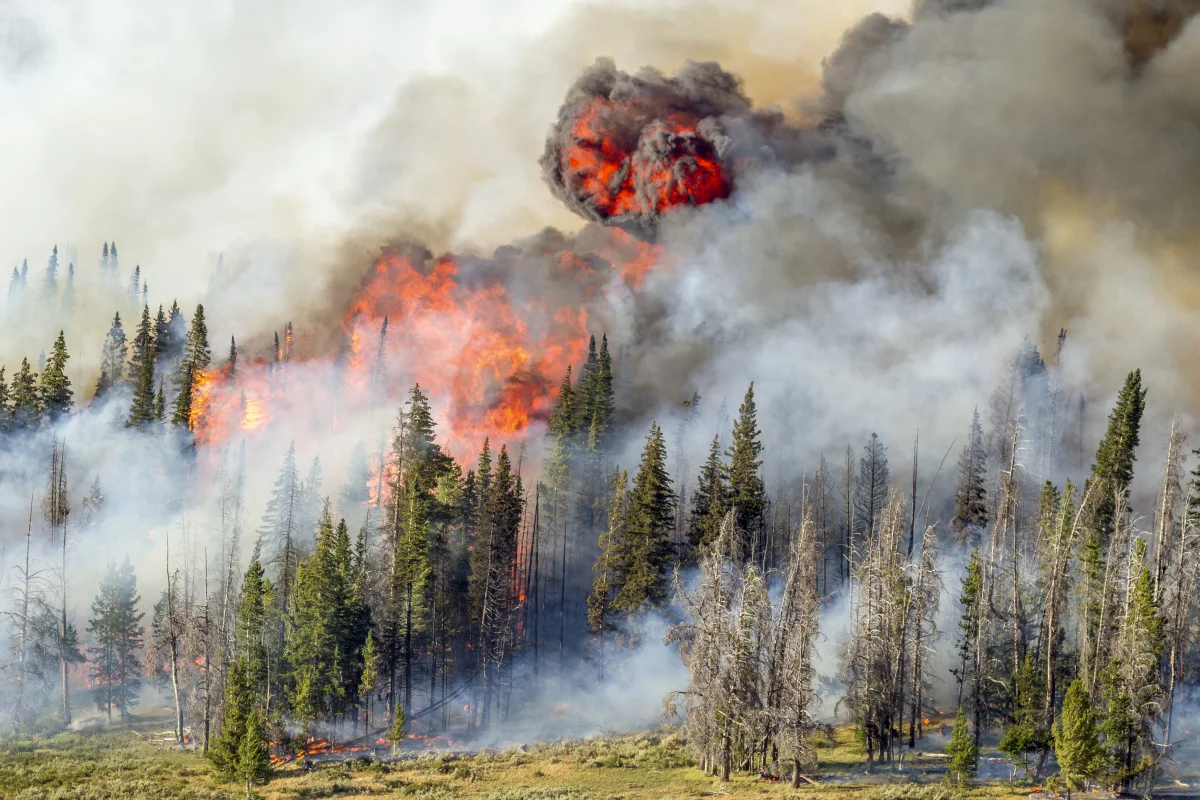
A ground fire — where grass and undergrowth burn — moves at 0.3–5 km/h. That's roughly walking pace, or a slow jog; you can outdistance it if you don't waste time. But once fire climbs into the treetops, everything changes: a crown fire can accelerate to 70 km/h in strong wind. No one can outrun that, walking or running.
A crown fire flings burning branches and pine needles dozens, sometimes hundreds of meters ahead, igniting new spot fires far in front of the main front. This is exactly how people end up surrounded: while they're running from the main wall of flame, the forest ahead of them is already catching fire.
Which Direction to Actually Move
The core rule from emergency services: exit the fire zone perpendicular to the fire's edge — sideways from the line the flames are advancing along. Reference points to head toward:
- Roads and firebreaks — wide gaps in the forest slow or stop a fire.
- Riverbanks and streams — water and a strip of damp ground act as a natural barrier.
- Clearings and cut areas — open spaces give fire nothing to catch on.
- Deciduous forest — if you have no other choice, move through birch and aspen stands rather than spruce: coniferous forest ignites instantly, while deciduous forest burns considerably more slowly.
What You Must Never Do
- Don't run uphill. Fire climbs a slope far faster than it spreads across flat ground — while running uphill is harder for you. If you're on high ground, head down.
- Don't hide in ditches or low ravines. A depression might seem safer, but once fire reaches a spot like that, oxygen burns off almost instantly — breathing becomes impossible even if the flames themselves never touch you.
- Don't try to cross through an already-burned section of forest. It's still smoldering, dense with smoke, and trees with charred roots can fall silently. An open field is different: if there's nothing left to burn, scorched ground cools quickly and becomes a safe spot.
If Your Path Is Cut Off
If escaping the fire isn't possible, look for a body of water. A river, lake, even a large puddle — get into the water, soak your clothing and whatever fabric you're using to cover your face. Choose a shallow spot free of reeds — dry reed beds ignite instantly.
If there's no water nearby, find an area with minimal vegetation: a rocky patch, a sandy bank, a plowed field. Remove any synthetic clothing — nylon and other synthetics melt when heated and stick to skin, turning a minor burn into a severe one. Natural fabric, or wet clothing, is the only acceptable option.
Clear a small patch of ground around you of branches and dry grass, lie face-down, and cover your mouth with damp fabric. Air near the ground carries less smoke and more oxygen — that difference can matter.
When to Call, and What to Say
Call the moment you smell smoke or spot fire: 112 (unified emergency line) or 8-800-100-94-00 (direct forest fire hotline). The dispatcher needs three things: your location (road, landmark, or GPS coordinates from your phone), where the fire is coming from, and roughly how large it is. Even if you assume someone else has already called, call anyway — a duplicate report is better than a missed one.
How Weather Signals Risk Level
Forest fires don't start "for no reason" — nearly always, they follow a combination of heat, dryness, and wind. If temperatures exceed 77°F, no rain has fallen in over a week, and wind has picked up, the fire danger rating in the forest is likely already high. On days like this, it's best to avoid forest walks away from roads entirely.
Fires slow down at night: air humidity rises, wind typically dies down, and temperatures drop. If a fire catches you in the evening, your odds of escaping it are better than during the day, when heat and wind push flames to their maximum speed.