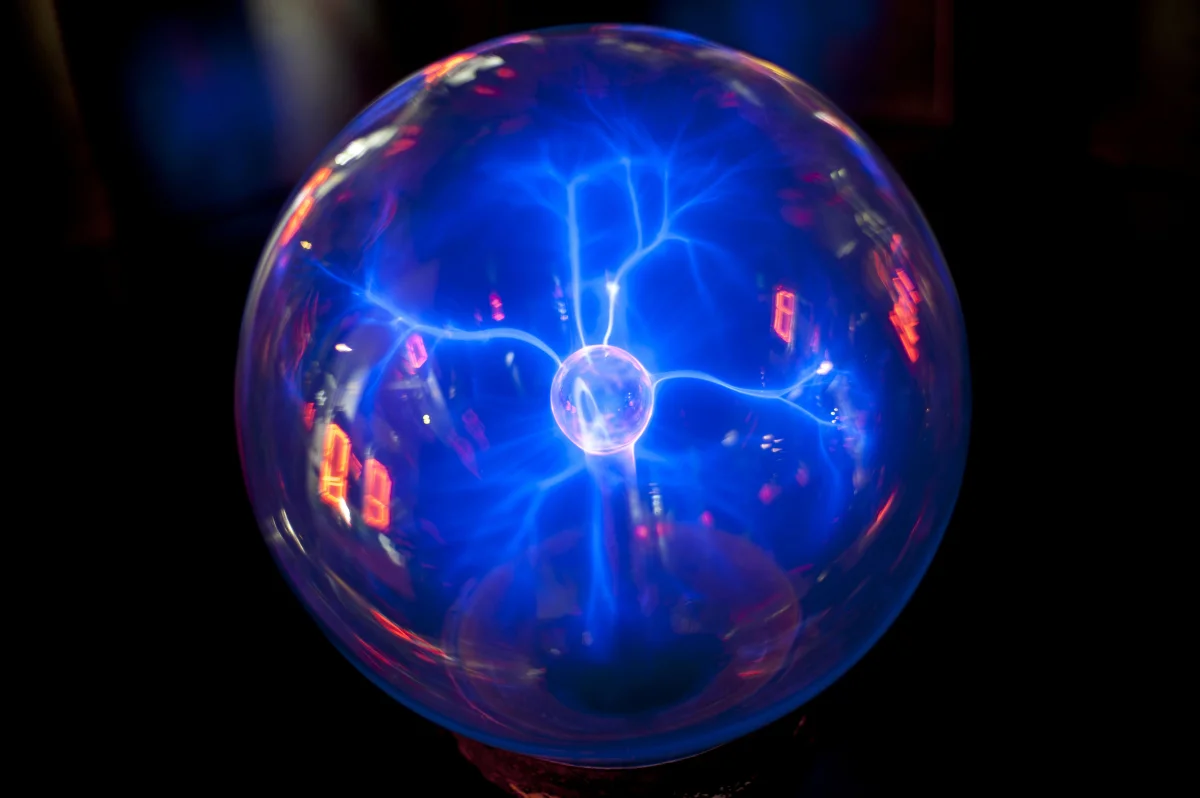
A glowing sphere drifts in through a window, floats across a room, and vanishes with a pop — thousands of accounts like this have been collected over the past four hundred years. Yet no laboratory on Earth has managed to reliably recreate what nature apparently produces in a fraction of a second.
Ball lightning is one of those rare cases where science honestly admits: we don't know what this is. Not "we haven't fully worked it out yet" — genuinely, there's no unified theory, no reproducible experiment, and not even full certainty that every account describes the same phenomenon. And yet, denying its existence outright has become considerably harder since 2012.
What Witnesses Describe
The descriptions are remarkably consistent, despite coming from different countries and different eras. A glowing sphere, most commonly 10 to 30 centimeters across, though accounts range from pea-sized to several meters in diameter.
Color runs white, yellow, orange, occasionally blue or green. It lasts anywhere from a few seconds to a couple of minutes. Movement is smooth, often parallel to the ground, sometimes changing direction as though navigating around obstacles.
It disappears in different ways: fading silently, popping with a bang, and in some cases exploding with destructive force. The first detailed account dates to 1638: during a thunderstorm, a fireball roughly two meters across flew into St. Pancras Church in Widecombe, England, injuring and killing several parishioners.
How Science Confirmed It's Real
Before 2012, ball lightning remained a phenomenon defined by "thousands of witnesses, zero instrumental data." Skeptics reasonably pointed out that eyewitness accounts are unreliable — people might be seeing an afterimage from ordinary lightning burned onto the retina, a hallucination triggered by an electromagnetic field, or simply making a mistake.
Everything changed in July 2012. A team of Chinese researchers from Northwest Normal University in Lanzhou, led by Jianyong Cen, was observing a thunderstorm on the Tibetan Plateau, with video cameras and slitless spectrometers trained on the sky.
Entirely by chance, they captured the moment an ordinary lightning bolt struck the ground — and a glowing sphere roughly five meters across immediately sprang up from the point of impact. It traveled about 15 meters and vanished after 1.64 seconds.
The spectrometer managed to record the chemical composition of the glow: silicon, iron, and calcium — elements characteristic of soil, not the atmosphere. This became the first instrumental confirmation in history that ball lightning genuinely exists.
The Abrahamson Hypothesis: A Ball of Burning Silicon
The Chinese team's data aligned with a theory proposed twelve years earlier by New Zealand chemist John Abrahamson of the University of Canterbury. According to his hypothesis, when lightning strikes the ground, the intense heat of the discharge (up to 30,000°C) instantly reduces silicon oxide in the soil into pure silicon.
Microscopic silicon particles get thrown into the air, clump together into a loose sphere, and then begin to burn, slowly oxidizing back into its original form. The glow is a byproduct of that combustion.
This hypothesis explains several observed traits: why ball lightning appears after an ordinary strike, why it glows, and why it fades after a few seconds (the silicon burns out). But it doesn't account for every case — for instance, ball lightning observed inside aircraft, inside submarines, or during clear weather with no storm in sight.
The Kapitsa Hypothesis: Standing Electromagnetic Waves
A different approach was proposed by Nobel laureate Pyotr Kapitsa back in 1955. In his version, ball lightning is an electrodeless discharge sustained by standing electromagnetic waves of ultra-high frequency, forming between the ground and a storm cloud — essentially a natural analog of a microwave oven, with energy concentrated at a single point.
Kapitsa's hypothesis is supported by several observations: ball lightning genuinely doesn't tend to form on sharp mountain peaks or tall buildings (where conditions for standing waves don't exist), and appears more often in valleys and enclosed spaces. But reproducing such a discharge in a laboratory still hasn't been achieved.
Why There's No Single Unified Theory
The problem is that ball lightning behaves too inconsistently across different accounts — and no single hypothesis covers every observation at once.
- Some spheres appear after lightning strikes the ground — fitting the silicon hypothesis.
- Others form indoors, passing through walls and windows — which fits an electromagnetic explanation better.
- Still others have been observed in clear weather near geological fault lines — an entirely different story, tied to energy released from the Earth's crust.
It's possible that the single label "ball lightning" actually covers several distinct phenomena with different underlying mechanisms, which simply look alike from the outside — a glowing sphere in the air. This idea shows up increasingly often in recent scientific publications.
Can It Be Created in a Laboratory?
Numerous attempts to produce ball lightning under laboratory conditions have yielded partial results. Scientists have managed to generate glowing spheres — for instance, by passing a powerful discharge through silicon-containing plates, or by vaporizing water with an electric arc. But every lab-made "ball" has existed for fractions of a second, not the tens of seconds natural ball lightning can sustain.
The one person who, according to contemporaries, could reliably produce ball lightning was Nikola Tesla — he demonstrated it publicly in his New York laboratory in the late 19th century. But he never revealed the underlying technique, and his experiments have never been successfully replicated.
What to Do If You See Ball Lightning
The phenomenon is extremely rare — by various estimates, the odds of seeing ball lightning in a lifetime run no better than one in several thousand. But if it happens, the main rule is: don't move, and don't make sudden movements. Ball lightning, according to accounts, often drifts along air currents, and a sudden movement of your own could redirect it toward you.
Don't try to touch it, throw objects at it, or wave your arms — its behavior is unpredictable, and while an explosion doesn't always happen, it can be destructive when it does. If a sphere drifts indoors, the best approach is to stay still and wait for it to vanish on its own — that usually happens within a few seconds.
One last thing: if you come through an encounter with ball lightning unharmed, write down everything you saw — size, color, trajectory, how long it lasted, any sounds. Every detailed account contributes to understanding a phenomenon science has been trying to solve for four centuries.