Nearly 12 meters of water a year — that's the height of a four-story building — and that's exactly how much falls from the sky onto a small mountain village in northeastern India.
Moscow gets around 700 mm of precipitation a year; Sochi gets about 1,500 mm, and that's already enough to complain about rainy weather. Now picture a place where 11,871 mm falls from the sky in that same span — nearly seventeen times Moscow's annual total.
This isn't a meteorological fluke or a one-off record — it's an ordinary reality for residents of India's Meghalaya state, whose name translates from the local language as "the abode of clouds."
Where the Rainiest Place Actually Is
The official record-holder for average annual precipitation is the village of Mawsynram, listed in the Guinness Book of World Records at 11,871 mm a year. It sits in the Khasi Hills of Meghalaya, in northeastern India, at an elevation of roughly 1,500 meters.
Just 15 kilometers from Mawsynram sits the town of Cherrapunji (known locally as Sohra) — the second-rainiest place on Earth, at 11,777 mm a year.
Cherrapunji was long considered the outright champion, and it still holds a record Mawsynram hasn't beaten: from August 1860 to July 1861, it received 26,470 mm of rain — more than 26 meters of water in twelve months.
Why the Rain Falls Specifically Here
The mechanism is simple to describe but unique in scale, and it's known as orographic precipitation. Here's how it works: from April to September, the southwest monsoon blows north off the Bay of Bengal. Warm, moist air travels roughly 400 kilometers across the flat plains of Bangladesh, picking up additional moisture from swamps and rice paddies along the way.
That moisture-saturated air current then slams into the steep slopes of the Khasi Hills. The climb forces the air to cool rapidly, and all the accumulated moisture condenses and comes crashing down as rain. Essentially, the mountains act like a giant condenser: everything the sea evaporated across hundreds of kilometers dumps onto a single slope.
The Rain Doesn't Fall Year-Round — But When It Does, It Doesn't Stop
An important nuance: the record-breaking totals are distributed extremely unevenly across the year. The bulk of the water falls during monsoon season, June through September, when downpours arrive daily — sometimes without pause for days at a stretch.
In July 1861, Cherrapunji received 9,300 mm of rain in a single month — more than Sochi gets in six years.
In winter, though — November through February — the region is comparatively dry and sunny. The contrast is so stark that Cherrapunji even experiences water shortages in winter, since almost all the rainwater runs off the steep slopes before it can soak into the thin layer of soil.
How People Have Adapted to Living Under a Waterfall
The residents of Mawsynram and Cherrapunji — the Khasi people — have lived for centuries in conditions where an ordinary umbrella is useless. Locals use knups — cone-shaped shields woven from bamboo and banana leaves, worn over the back and head like a shell. Wearing one, you can work in a field without the downpour getting in the way: your hands stay free, and water simply runs off the sloped surface without pooling.
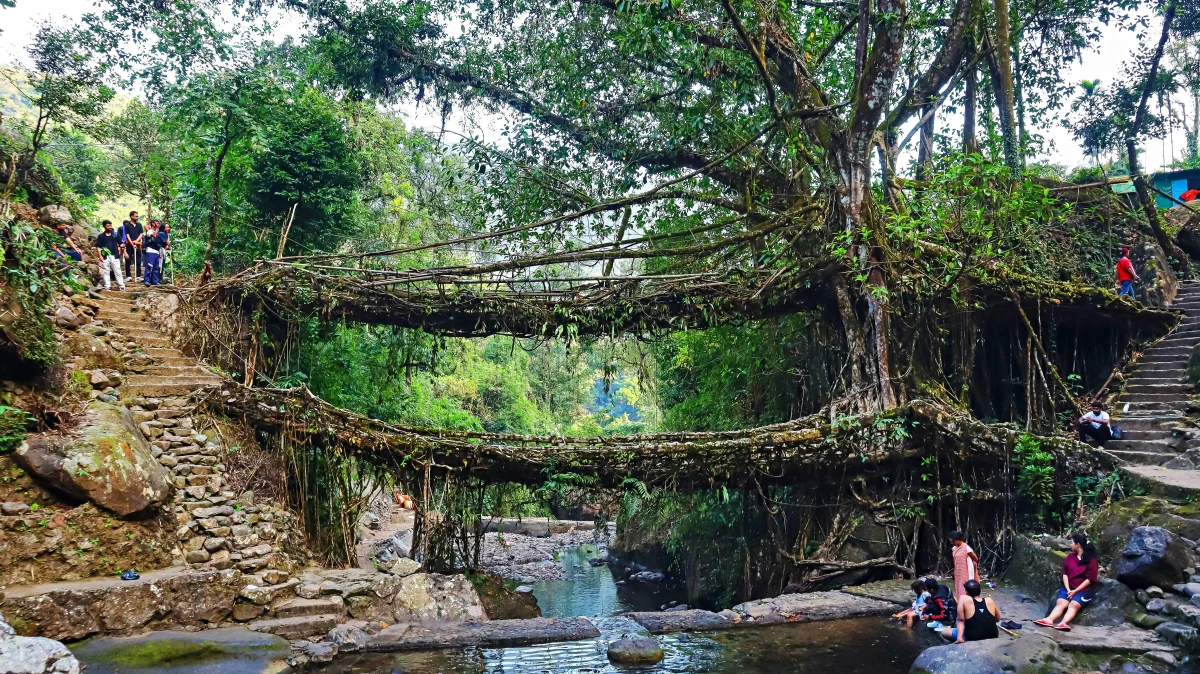
But the most striking adaptation is the region's living root bridges. Ordinary wooden bridges rot within a few years in this climate, and stone ones wash away under the force of the water. So the Khasi learned to guide the aerial roots of the rubber fig tree across rivers and gorges, gradually shaping them into crossings.
Growing a single bridge takes 10–15 years, but once established, it only grows stronger with age and can last for centuries. Some of these structures are already over 500 years old and can support up to 50 people at once.
Are There Other Contenders for the Title
The debate over the world's rainiest place isn't quite as settled as the Guinness listing suggests. A few other spots on the map challenge India's record-holders:
- Lloró, Colombia — a small town in the Chocó department, where some estimates put average annual rainfall at 12,700–13,300 mm. The catch is that systematic weather monitoring here hasn't been conducted for as long or as rigorously as in India, so Guinness hasn't officially recognized these figures yet.
- Mount Waiʻaleʻale on the island of Kauai, Hawaii — around 11,500 mm a year. The same orographic mechanism is at work: moist Pacific air slams into the slope of an extinct volcano.
- Big Bog, Hawaii — 9,293 mm a year, with soil so waterlogged that wooden boardwalks have been built over the ground for hiking trails.
In every case, the cause is identical: moist ocean air meets a mountain slope in its path and is forced upward, dumping all its water in one concentrated spot.
What Does This Have to Do With Russia
On a global scale, Russia's own "rain record-holders" look modest, but the range within the country is enormous. The wettest place in Russia is Achishkho, near Krasnaya Polyana (Sochi), which receives around 3,200 mm of precipitation a year.
That's four times less than Mawsynram, but four and a half times more than Moscow. The cause is the same: an orographic effect, where moist air off the Black Sea slams into the ranges of the Western Caucasus and releases its moisture on the windward slopes.
Can You Actually Visit
Cherrapunji and Mawsynram are genuine tourist destinations, though not mass-market ones. The best time to visit is November through February, once the monsoon has ended, skies are clear, and temperatures hold around 50–59°F (10–15°C).
Visiting during peak monsoon (July–August) means witnessing record-breaking rainfall firsthand, but it also means washed-out roads, visibility dropping to a minimum, and the very real possibility of not being able to reach the living bridges at all.
Practically speaking: the nearest major airport is Guwahati, in the neighboring state of Assam, roughly 150 km from Cherrapunji along a mountain road. Bring waterproof shoes and clothing regardless of season — even in winter, sudden brief downpours are a reminder of exactly where you are.