News reports sometimes say "smerch," sometimes "tornado," and every time it seems like two different phenomena are being described. In reality, meteorologists settled this long ago — the confusion just hasn't caught up.
The moment a video of a funnel over a field near Kursk shows up online, the comments fill with debate: "that's a smerch, tornadoes only happen in America." Or the reverse: "smerch means over water, tornado means over land." Both claims are myths. Let's break down how the terminology actually works, and why a vortex doesn't change based on what you call it.
The Short Answer: Yes, It's the Same Thing
Smerch and tornado are two names for the same phenomenon. Both words describe an atmospheric vortex that forms inside a storm cloud and stretches down to the surface of the land or water as a rotating funnel.
As meteorologists at the Phobos weather center have explained, the difference between the two terms is roughly like the difference between "shepherd" and "cowboy" — the substance is identical, and the name simply depends on which country you're in.
Smerch is a Russian word, derived from the Old Russian smŭrchĭ (meaning cloud or storm cloud). Tornado is Spanish, from the verb tornar — to spin, to turn. The physics, the formation mechanism, and the consequences are identical.
Where the Confusion Comes From
The confusion arose because English-language meteorology uses two separate terms for vortices over land and over water: tornado for land, waterspout for over water. In Russian, the word smerch has historically applied to both cases without distinction, while the word tornado arrived later — alongside American films and news coverage.
As a result, some people concluded that smerch and tornado must be different phenomena, and started hunting for nonexistent distinctions between them — that a smerch is supposedly weaker, or only happens over water, or lasts a shorter time. None of this holds up scientifically.
How the Vortex Actually Forms
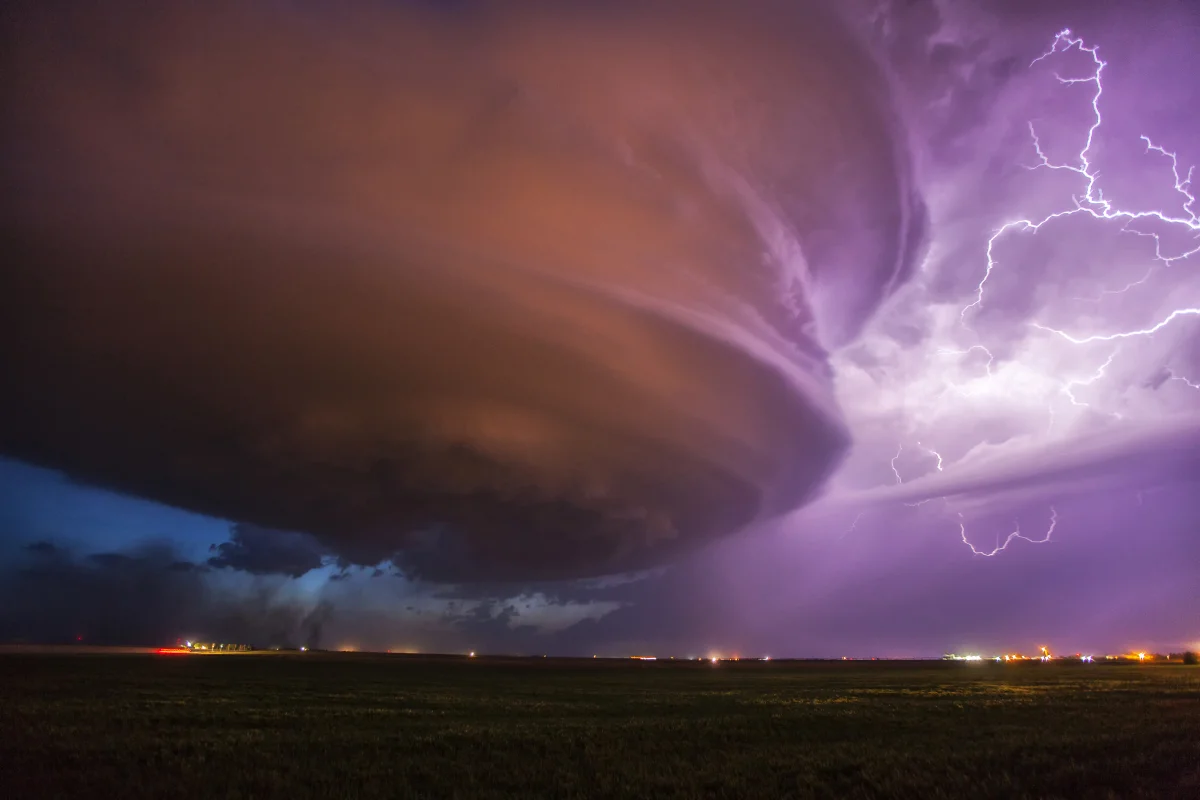
The mechanism is identical for any smerch/tornado. Inside a powerful storm cloud — a cumulonimbus — a rotating zone of air develops, known as a mesocyclone. A funnel begins descending from the base of the cloud: internal airflows spiral downward toward the ground, while outer flows rise upward. Pressure inside the funnel drops sharply, and it's this low-pressure zone that draws in everything nearby.
Wind speeds inside the funnel can reach 100 m/s or higher — that's over 350 km/h. Diameter ranges from a few dozen meters up to two kilometers. Lifespan runs from a few minutes to a few hours.
The Fujita Scale: How Strength Is Measured
Tornado intensity isn't assessed by wind speed directly (extremely difficult to measure inside the funnel itself), but by the scale of destruction. This uses a scale proposed in 1971 by American meteorologist Theodore Fujita, running from F0 to F5.
- F0 — light damage: broken branches, damaged signs.
- F1 — torn-off roofs, overturned trailers.
- F2 — uprooted trees, destroyed light structures.
- F3 — walls of substantial buildings destroyed, heavy objects lifted into the air.
- F4 — well-built houses leveled to the ground.
- F5 — total destruction of everything in its path.
The scale is the same one, regardless of whether you call the phenomenon a smerch or a tornado.
Do Tornadoes Happen in Russia
A common misconception holds that Russia sits too far north for phenomena like this. In reality, tornadoes are recorded regularly across the country — just less often, and typically weaker, than in America's "Tornado Alley."
The most destructive case on record occurred on June 9, 1984, when at least eight tornado funnels formed simultaneously over the central regions of the RSFSR. One of the vortices passed through Sheremetyevo Airport, damaging aircraft and cutting a wide swath still visible on satellite imagery to this day.
The most catastrophic was the Ivanovo tornado, rated F4: wind speeds inside the funnel exceeded 100 m/s, entire residential blocks were destroyed, and, according to official figures, 69 people died.
Tornadoes have also been recorded in Moscow (1904), Nizhny Novgorod (1974), Vladivostok (1997), Blagoveshchensk (2011), Kurgan Oblast (2017), and many other locations.
What People Often Mistake for a Tornado
Not every spinning column of air is a tornado. On a hot day, over fields, construction sites, or ordinary asphalt, you might see a spinning column of dust a few meters tall. This is a dust devil — and it has nothing to do with a tornado.
The key difference: a tornado always forms from, and stays connected to, a storm cloud, while a dust devil forms at ground level from uneven solar heating, with no cloud involvement whatsoever.
A dust devil typically stands 10–20 meters tall (occasionally up to 100–150), spans one to five meters in diameter, and lasts anywhere from a few seconds to a couple of minutes. It generally carries no destructive force.
Why the US Gets More of Them
This comes down to geography, not terminology.
Central North America is a flat plain with no mountain barriers between the Gulf of Mexico and Canada. Warm, moist air from the south collides freely with cold, dry air from the north, creating ideal conditions for powerful storms and, consequently, tornadoes.
In Russia, terrain and the arrangement of air masses don't produce that kind of regular "collision" — so tornadoes happen, but far less frequently.
The US records more than a thousand tornadoes a year. Russia records roughly a few dozen, and most of those pass over sparsely populated areas and go unnoticed.
What to Do If a Funnel Forms Nearby
If you see a dark, rotating cone extending down from a storm cloud, don't film it on your phone — find shelter. The best option is a basement or an interior room of a substantial building with no windows.
If no shelter is available, lie flat in any natural depression — a ditch, a gully — and cover your head with your arms. Staying in a car is not an option: even a weak F1-rated tornado can flip a vehicle.
And above all — don't try to "outrun" the funnel by car. A tornado can change direction, and its ground speed can reach 50–60 km/h. The odds of correctly guessing which way it will turn are close to zero.