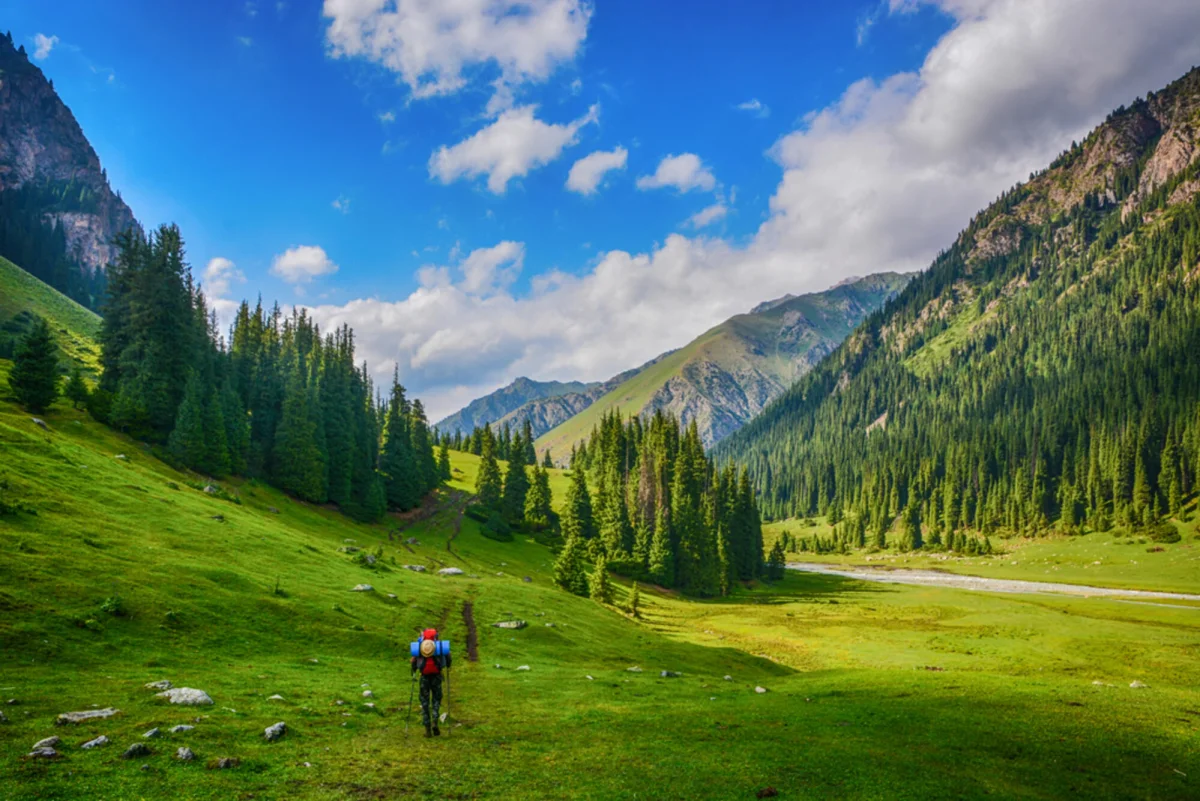
In July it's over 30°C in Bishkek, while a few hours' drive away, at the high-altitude Lake Son-Kul, there can be frost at night. Kyrgyzstan is a country where the weather depends less on the month than on how high above sea level you are.
A typical tourist mistake in Kyrgyzstan is to check the forecast for Bishkek and pack for the heat. A day later, they find themselves on a mountain pass in shorts in a hailstorm, and in the evening, outside a yurt by Son-Kul, they pull on everything they've brought.
The difference between the valleys and the mountains here is huge: it can be 10–20°C colder in the mountains than down below. We look at how Kyrgyzstan's climate works, and what to prepare for in different parts of the country.
A Country That's Almost All Mountains
Most of Kyrgyzstan lies within the Tian Shan mountain system, and the far south-west in the Pamir-Alay. The country's highest point is Jengish Chokusu (Victory Peak), 7,439 metres, on the border with China. Above 4,000 metres lie extensive glaciers that feed the rivers.
The climate is continental: dry, with big temperature swings between day and night, and between summer and winter. But above all, the temperature falls sharply with altitude.
According to the Krugosvet encyclopaedia, the average July temperature is 20–27°C in the valleys, 15–17°C in the middle mountains and 5°C or below in the high mountains. In January, it averages −2 to −8°C in the valleys, down to −20°C in the middle mountains and around −28°C in the high mountains.
Bishkek and Osh: Hot Summers and Dry Autumns
The towns in the valleys are the "warmest" part of Kyrgyzstan. In Bishkek (760 metres above sea level), July averages 32°C by day and 18°C at night. Winters are cool: in January it's about 3°C by day and −7°C at night, and frosts down to −15°C occur almost every year.
In Osh in the south (965 metres), summer is just as hot, at 31°C by day in July, and there's hardly any rain in summer: only about 10 mm falls in July and August. In both Bishkek and Osh, the wettest months are in spring: April and May.
For the towns and valleys, the best times are mid-April to mid-May and mid-September to mid-October: already, or still, warm, but without the summer heat.
Issyk-Kul: The Lake That Almost Never Freezes
Lake Issyk-Kul lies at an altitude of about 1,600 metres and creates a milder microclimate around it. It's one of the deepest lakes in the world, at up to 668 metres, and its water is brackish, so the lake almost never freezes.
In summer, it's 23–26°C by day on the shore, but the nights are cool: in Karakol, it's around 12°C at night in July.
After sunset it gets cold quickly, and the wind off the lake makes it feel even cooler. Swimming is comfortable from mid-July to the end of August: in early June the water is still cold, and it's at its warmest in August.
Naryn and Son-Kul: Summer at Altitude
The higher you go, the shorter the summer. In Naryn (2,040 metres), July is 25°C by day but just 11°C at night. Winters here are harsh: in January, nights average −19°C.
Lake Son-Kul lies at 3,016 metres, and that's a completely different climate. In summer it's no warmer than 15°C by day, and at night the temperature drops below freezing. The lake is frozen from late September to early June, and in winter the road to it ices over and it can't be reached. Visitors to Son-Kul stay in yurts insulated with felt and heated by wood-burning stoves.
The High Mountains: Snow in July Is Normal
At 3,600 metres and above, summer is barely different from late autumn. At the weather station by Lake Petrov (3,635 metres), July averages 12°C by day and around 0°C at night. Above 3,000 metres, snow or hail is possible even in July, there may still be snow on the high passes in June, and the first snow falls here as early as September.
In summer, the mountains often see thunderstorms, hail and sudden cold snaps.
And in the rainy season there's another danger: mudflows. In July 2026, for example, Kyrgyzstan's emergencies ministry warned of downpours and mudflows in the mountains from July 21 to 25, and urged people to stay away from riverbeds and dry sai, gullies down which water can suddenly rush during heavy rain.
The Climate Is Changing Before Our Eyes
The weather in Kyrgyzstan is becoming less predictable. "We're seeing seasonal shifts: spring is arriving earlier, summers have become hotter, and less precipitation falls in winter," says director of Kyrgyzhydromet, the national weather service, Daurbek Sakyev.
This is especially noticeable in the glaciers. Over 70 years, the area of glaciers in the Tian Shan has shrunk by about 16%. The Adygene glacier in the Ala-Archa gorge, which is popular with tourists, has retreated almost a kilometre since 1962.
When to Go to the Mountains
For the high mountains, including Son-Kul, treks and nights in yurts, the best time is July and August. For moderate altitudes of around 2,000 metres, the season is longer: May to September. In September the mountains are often clear and you get good views, but snow on the passes can't be ruled out, and in October it can close the roads.
In winter, passes may be closed temporarily because of snowfall, avalanche risk or ice. If your trip falls in the cold season, be sure to allow some spare days.
What to Pack and What to Remember
- Pack in layers
Even in summer you'll need a warm jumper, a waterproof jacket, a hat and gloves. In the sun during the day you can walk around in a T-shirt, but in the evening at 3,000 metres you can't do without a down jacket.
- Protect yourself from the sun
At altitude, ultraviolet radiation is stronger, and you can get sunburnt even in cool weather. Sunscreen and sunglasses are just as essential in the mountains as on the beach.
- Don't go by the Bishkek forecast
The weather in the capital, at Issyk-Kul and at Son-Kul can be radically different. Check the forecast for the specific place and altitude, and keep an eye on text alerts about severe weather warnings.
- Climb gradually
If you go above 2,500–3,000 metres too quickly, you may get a headache and feel weak. It's best to build days into your route to acclimatise to the altitude.
- Get your documents and money ready
Russians can enter Kyrgyzstan even with an internal passport and stay there without registering for up to 30 days. Direct flights from Russian cities go to Bishkek and Osh. Russian bank cards don't work here, so bring plenty of cash.