Mushroom pickers study the weather forecast more closely than forecasters do: the rain, the night-time temperatures, whether "the ground has warmed up". In Russia, the mushroom season runs from April almost until winter, but the truly bountiful weeks can be counted on the fingers of one hand, and they're easy to miss.
Every summer, the same story plays out on social media: in one region, pickers carry buckets of porcini out of the forest, while in another there's nothing at all. The year 2026 showed this especially clearly. In the Leningrad Region and Karelia the season was noticeably late, although in some places pickers still found porcini.
In October, mycologist Irina Filippova, chief executive of the Gribnaya Apteka ("Mushroom Pharmacy") chain, called this season the poorest in 30 years. We look at what the harvest depends on and how to catch your own mushroom wave.
The Mushroom Calendar for Central Russia
Mushrooms don't grow evenly throughout the season but in waves, periods of mass fruiting. The timing shifts every year, but the general order is as follows:
- April–May: the first spring mushrooms, morels and false morels. They appear when the soil has warmed to 5–8°C and stays moist for at least a week.
- Late May to late June: the first summer wave. These are the so-called kolosoviki, porcini and birch boletes that come up at roughly the time the cereal crops are coming into ear (kolos in Russian). That's how the Yaroslavl mycologist Olga Lazareva, for example, explains the name.
- Late July to early August: the summer wave, when people pick chanterelles, porcini and birch boletes.
- Late August to mid-October: the main autumn wave. Porcini and chanterelles gradually become scarcer, while gilled mushrooms become more plentiful: brittlegills, milk caps and then honey fungus.
- Late autumn: the season ends differently from year to year. In some years people go mushrooming almost until New Year, in others it's all over by September or October. After hard frosts, only the species adapted to them remain in the forest.
The peak of the whole season in central Russia usually comes in August and September. And Stanislav Krivosheyev, a member of the St Petersburg Mycological Society, points out that in north-western Russia, September is often the most productive month.
What Mushrooms Need: Warmth and Water
Mushrooms are the fruiting bodies of a mycelium that lives in the soil for years. To "shoot up", it needs two conditions at once: moisture and warmth.
For porcini to grow in large numbers, according to biologist Elina Mironova, night-time temperatures need to be about 15–20°C and daytime temperatures up to 25°C. That's why experienced pickers look not just at daytime temperatures but at night-time ones too: cold nights slow growth even after good rain.
But moisture alone doesn't guarantee a harvest. Too much water harms the mycelium as much as drought does: when the pores in the soil fill with water, the mycelium can't get enough air. That's exactly what happened in north-western Russia in 2026: after a snowy winter and a drawn-out spring, the summer was wet, and specialists explicitly described the excess moisture as bad for the mycelium.
Yekaterina Polyantseva, a blogger and member of the St Petersburg Mycological Society, named frequent rain and thunderstorms as the main obstacle, although she stressed that the situation wasn't abnormal: by the end of August, mushrooms had started to appear around Lake Onega and along the shores of Lake Ladoga.
How Many Days After Rain Should You Head to the Forest?
This is the key question, and mycologists give similar answers.
Maxim Dyakov, a leading specialist in the Department of Mycology and Algology at Moscow State University's Faculty of Biology, advises "waiting three or four days" so that the mushrooms have time to grow.
Nikita Komissarov, a mycologist at Moscow State University with a PhD in biology, recommends "waiting three to five days" after a good downpour. If the rain falls steadily for two or three days in a row, though, you can go as soon as the next day.
According to Elina Mironova, porcini usually start growing in large numbers two to four days after rain.
There are no guarantees, though: if the rain followed a long drought, you'll have to wait longer. Mushrooms may appear after a few days, after a week, or not at all if the nights are cold.
Where to Look
Each mushroom is "tied" to particular trees, with which its mycelium forms a partnership. Here's a rough guide:
- slippery jacks: near young pines and larches;
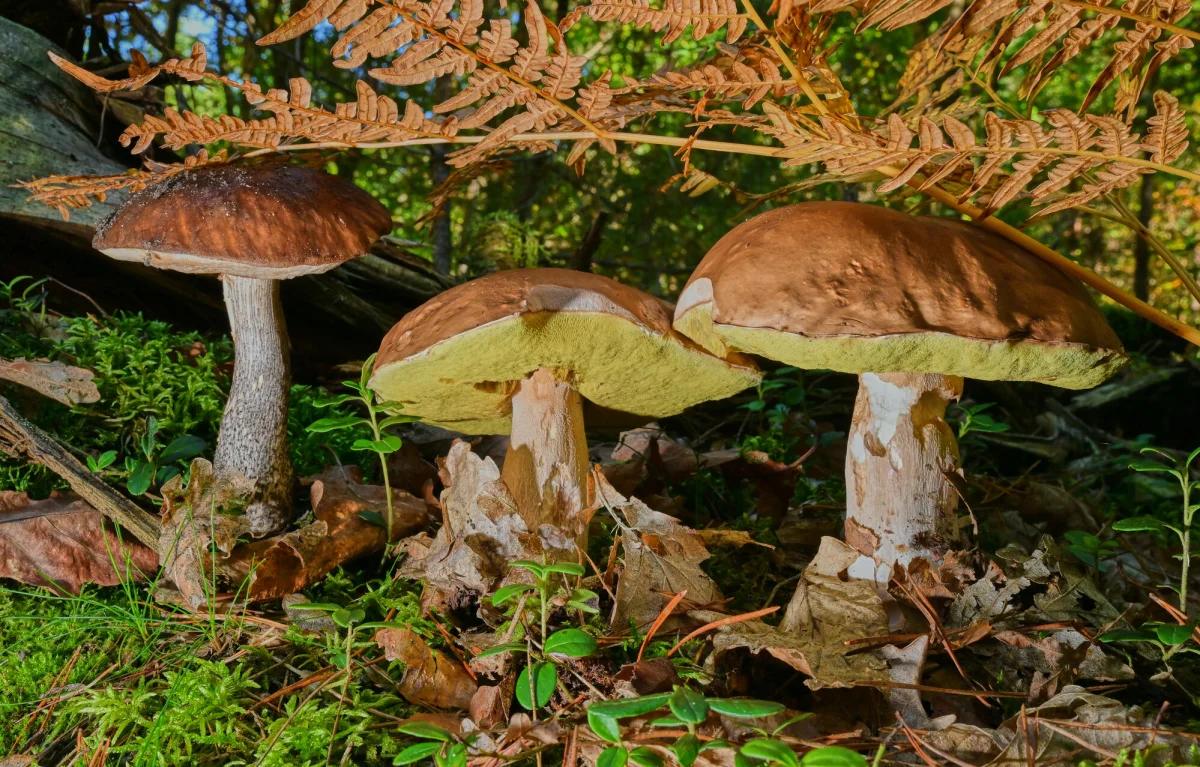
- porcini: near both conifers and broadleaf trees, more often in mature woodland;
- birch boletes: in birch woods;
- orange birch boletes (known in Russian as "under-aspen" mushrooms): among aspens, although their mycelium also partners with birch, pine or larch.
It's also worth checking boundaries: forest edges and the margins of fields and bogs.
But it's best to avoid spots by roadsides, in towns and near industrial sites: mushrooms accumulate harmful substances from the soil and air.
How Not to Miss Your Wave
- Watch the weather in advance. A warm week with rain and nights no colder than 15°C is the main signal. Count three to five days from a good rain: that's your window for a trip.
- Go by your own region, not your neighbours'. Waves arrive at different times in different regions: in 2025, the main wave in the Leningrad Region came in the second half of August, while in 2026 the season there only really got going by the end of the summer. Local news and mushroom-picking groups on social media are the quickest way to find out whether the mushrooms have "come up".
- Don't wait for the weekend if the wave is already under way. Between waves there are noticeably fewer mushrooms, and in popular forests they're picked quickly.
- Choose firm mushrooms. Nikita Komissarov advises taking solid specimens with no dark patches or soft spots. Waterlogged mushrooms don't travel home as well.
And the main rule that every mycologist repeats: only pick mushrooms you're absolutely certain are edible. If in doubt, leave it out.