Every summer, a green film appears along the banks of the Volga, looking like spilled paint. Locals call it "blooming" and are no longer surprised by it. But this familiar sight is a sign that the Volga has long since stopped behaving like a river and become a chain of warm reservoirs.
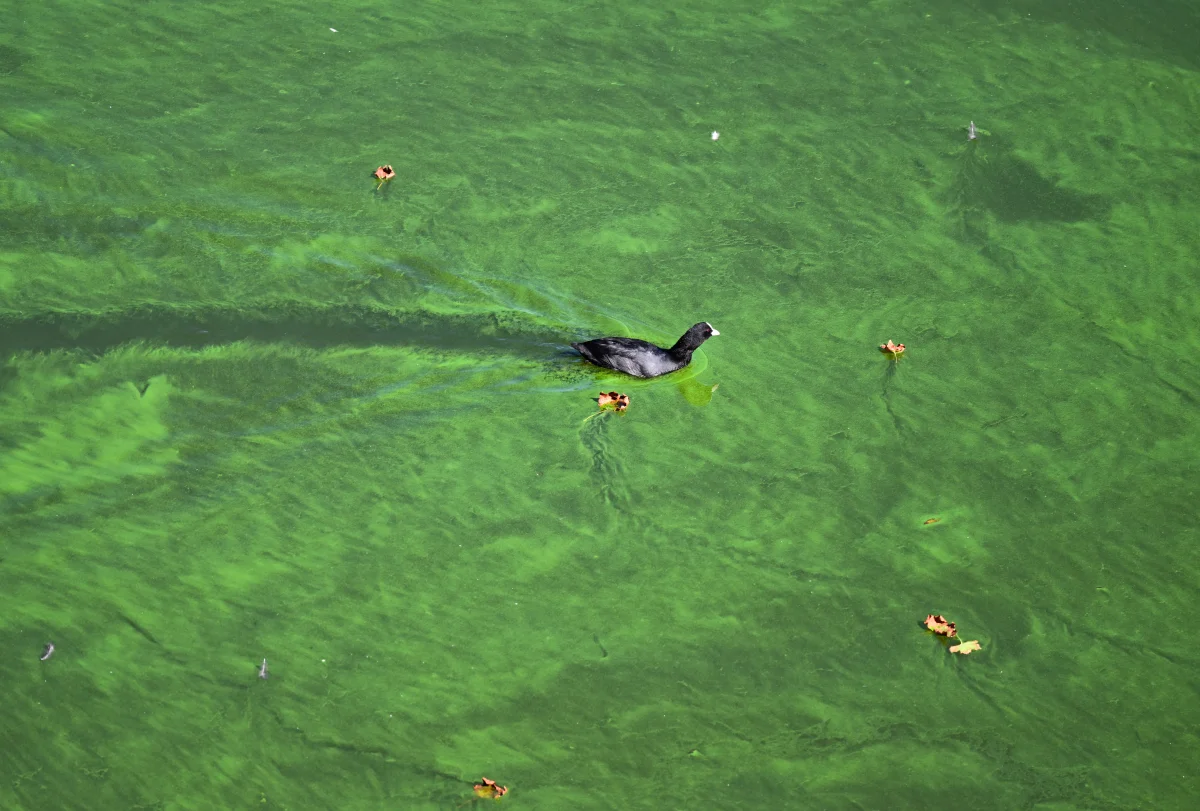
On July 5, 2026, residents of Samara noticed that the water by the opposite bank of the Volga, across from the second section of the embankment, had turned bright green. A video of it spread across social media, even though the sight is a familiar one in towns along the Volga.
In Tatarstan, the environment ministry openly calls the Volga's bloom "an annual phenomenon". We look at why the river turns green, when it happens, and why the problem has gone unsolved for years.
What Colours the Water
The water gets its green colour from cyanobacteria, also known as blue-green algae. They are among the oldest organisms on the planet.
"Blue-green algae are 3.5 billion years old. They shaped our planet's atmosphere," notes Andrei Ardakov, acting head of the environmental protection department at the Samara Region's Ministry of Natural Resources.
In small numbers, cyanobacteria are always present in the water and are even beneficial: they release oxygen and serve as food for some fish, such as silver carp and grass carp. The problem starts when they multiply explosively and cover the water in a continuous film.
When the Bloom Begins
Cyanobacteria multiply rapidly once the water warms above 20°C. The Volga's bloom usually peaks in August.
But in 2026, it all began earlier. A cool June was followed by sudden heat, and the water warmed up quickly. By the end of the first ten days of July, according to the Volga Region Directorate for Hydrometeorology and Environmental Monitoring, the water was about 24°C near Tolyatti, 22.5–23°C near Syzran and about 21°C near Samara. The bloom had started by early July.
It ends the same way, depending on the weather. According to Samara biologist Sergei Simak, the bloom can subside if the weather turns cooler and there's prolonged rain with strong wind: the water cools down and mixes.
Why the Volga Is No Longer a River
The main reason for the annual bloom is that for almost its entire length, the Volga no longer flows like a river. A cascade of hydroelectric plants and eight reservoirs has been built on it, from the Ivankovo Reservoir in the Tver Region to the Volgograd Reservoir. The current in them has slowed dramatically.
"The Volga as a whole has ceased to be a full-flowing river. It is turning into a network of stagnant reservoirs," says Professor Natalya Lazareva, head of the department of land management and ecology at Samara State University of Economics.
Slow-moving water warms up faster than a fast-flowing river, especially in stagnant bays and shallows. The banks that are silting up and becoming overgrown heat up the most, and that's where cyanobacteria multiply first. The most visible bloom zone is the Kuibyshev Reservoir, the largest on the Volga.
What Feeds the Algae
Warmth is only half of the equation. The other half is food: compounds of phosphorus and nitrogen. These are the same substances found in fertilisers, and they work the same way for algae.
They reach the Volga in several ways:
-
from fields, where mineral fertilisers are applied;
-
with urban runoff, including traces of washing powders and detergents, which are high in phosphates;
-
with untreated domestic wastewater.
According to Andrei Ardakov, up to 70% of polluting discharges enter the Volga through diffuse runoff, that is, with no treatment at all: from fields, private houses and city streets without storm drains. Sources like these can't be "closed off" with a single pipe or served by a single treatment plant.
Why the Problem Still Hasn't Been Solved
Since 2017, Russia has had a project called Healthy Volga ("Ozdorovleniye Volgi"). Its aim is to cut the share of polluted wastewater discharged into the river threefold. According to Roshydromet, Russia's weather and environmental monitoring service, water quality in the Volga improved steadily in 2019–2024 compared with 2010–2018.
But in November 2025, at a meeting of State Duma committees, it emerged that much was wrong with the treatment plants. During inspections, Rosprirodnadzor, the environmental watchdog, found 1,471 breaches of environmental requirements.
Deputy Natural Resources Minister Maxim Korolkov called the problem systemic: at many treatment plants, the equipment and design documentation don't meet the required standard.
And even if every treatment plant worked perfectly, there would still be the diffuse runoff, that same 70%. Most importantly, the reservoirs aren't going anywhere: the slowed current and warm water will create conditions for blooms every summer.
Why Blooming Water Is Dangerous
Cyanobacteria release toxins, especially when they die off en masse. According to Sergei Simak, swallowing such water by accident can cause poisoning, while contact with the skin and mucous membranes can cause redness, a burning sensation and conjunctivitis.
"Swimming in such water is strongly discouraged," the biologist says.
There's an environmental danger too: when the algae die and decompose, oxygen levels in the water fall, which can lead to fish deaths.
How to Avoid Green Water
-
Look at the water before you go in. A green or blue-green film on the surface, murky "pea soup" water, clumps near the shore and an unpleasant smell are all signs of a bloom. It's best not to go into such water, even if it's an official beach.
-
Avoid stagnant spots. Blooms are worst in shallows, quiet bays and on shores where the wind drives the algae. Where the water is moving, the bloom is usually weaker.
-
Keep an eye on the weather. After several hot, still days, the chance of a bloom rises sharply. Conversely, cooler weather, rain and strong wind can clear the water for a while.
-
Check Rospotrebnadzor's updates. At the height of a bloom, Russia's consumer health watchdog warns of the risks of swimming at specific beaches: in summer 2026 there were such warnings in the Samara Region, for example.
And there's one small thing everyone can do: choose phosphate-free washing powders and detergents. There are plenty of them in the shops now, and every kilogram of phosphorus that doesn't reach the Volga means less food for the green film next summer.