Bashkiria usually gets penciled into summer plans, but two of its best seasons are actually golden autumn in the mountains and winter at the ski resorts — when there are far fewer tourists and no fewer impressions.
The republic occupies the western slope of the Southern Urals — mountain ridges, taiga forests, mountain rivers, caves with Paleolithic paintings, and lakes with turquoise water. From Moscow, it's a ninety-minute flight to Ufa.
But distances within the region are serious: from the capital to the major natural landmarks ranges from 100 to 380 kilometers. Getting around without a car or an organized tour is tough.
Summer — peak season, peak crowds
From June through August, Bashkiria sees +22–26°C, reaching +30°C in direct sun. This is the time for river rafting, trekking, and horseback expeditions. The Belaya, Ai, Yuryuzan, and Zilim rivers are among the country's top rafting routes for anyone tired of beaches.
Lake Bannoye is the most popular swimming spot. Crystal-clear water, depths reaching 28 meters, mountain ridges all around. Nearby there's a resort with full infrastructure, SUP boards, and cafés. In July–August the shore is densely packed with tents and cars — book accommodation well in advance.
Waterfalls are a story of their own. Atysh, which pours from inside a grotto; Gadelsha, a three-tiered cascade; Kuperlya, with a natural stone arch. They're at their most powerful in late May through early June — by August, after a dry spell, some can shrink to a thin trickle.
Key stops on a summer itinerary:
- Shulgan-Tash — a nature reserve home to Kapova Cave, which contains rock paintings estimated at 16,000 years old. Next door is a modern museum complex where you can view replicas of the petroglyphs without entering the cave's fragile ecosystem.
- Mount Iremel — the second-highest peak in the Southern Urals at 1,582 meters. The ascent takes 5–7 hours, but the view from the top is one of the region's defining postcard images.
- The Shikhans — ancient coral reefs left behind by the Permian Sea 230 million years ago. Three limestone hills rising from the steppe — Toratau, Kushtau, and Yuraktau — form part of a geopark.
- Muradymovo Gorge — cliffs, caves, and the Bolshoy Ik River. One of the most beautiful spots in southern Bashkiria, but nearly 300 kilometers from Ufa.
Autumn — for those who value silence
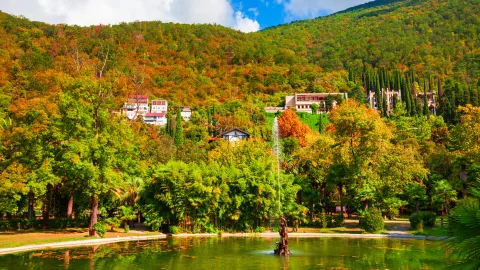
September and the first half of October are a deeply underrated season. The mountains turn gold and crimson, the air is crystal-clear, the mosquitoes are gone, and tourist numbers drop several times over compared to summer. Temperatures are comfortable: +10–18°C during the day, cool at night.
Autumn is ideal for hiking, visiting the Shikhans, and photography expeditions. The Inzer Zubtchatki — a stone ridge with fantastically shaped rock formations — look especially striking in autumn light. Horseback tours through alpine meadows run until mid-October.
On the practical side: guesthouses lower their prices, the roads are clear, and freshly harvested Bashkir honey — one of the region's prized exports — starts appearing at the markets.
Winter — skiing and beyond
From December through March, Bashkiria operates three main ski resorts: Abzakovo, Mratkino, and Bannoye (Yakty-Kul). The elevation drop is more modest than in the Caucasus, but the runs are well-groomed, the lifts are modern, and the lift lines are a fraction of what you'd face at Krasnaya Polyana.
Winter temperatures range from –10 to –20°C, and snow cover is reliable. For non-skiers, there are snowmobile routes, ice fishing, and horseback rides through winter forest.
A separate winter destination is Yangan-Tau, known for its geothermal vapors. Hot gases rise from underground year-round, and a sanatorium has operated here since Soviet times. In winter, the contrast between the freezing air and the warm stones is particularly vivid.
Spring — extreme rafting season
May in Bashkiria means "big water." Rivers swell after the snowmelt, waterfalls roar, and for experienced rafters it's the best time of year. Beginners are better off waiting until June, when water levels drop and routes become safer.
The blooming slopes of the Southern Urals in May are a spectacle of their own. But the weather is unstable: daytime might hit +20°C while nighttime hovers around zero. Warm layers are non-negotiable.
What to know before you go
Bashkiria is not a resort region with polished service. Many natural attractions are far from paved roads, cell coverage is spotty, and your GPS may lead you to a dead end.
For serious routes — Iremel, the Inzer Zubtchatki, Atysh waterfall — it's best to go with local guides or an organized group.
From Ufa, it's convenient to plan day trips or overnighters radiating outward. But if you want to see as much as possible, budget at least a week — and be prepared for the fact that half your time will be spent on the road. Bashkiria rewards that patience with landscapes you'd be hard-pressed to find anywhere else in Russia.