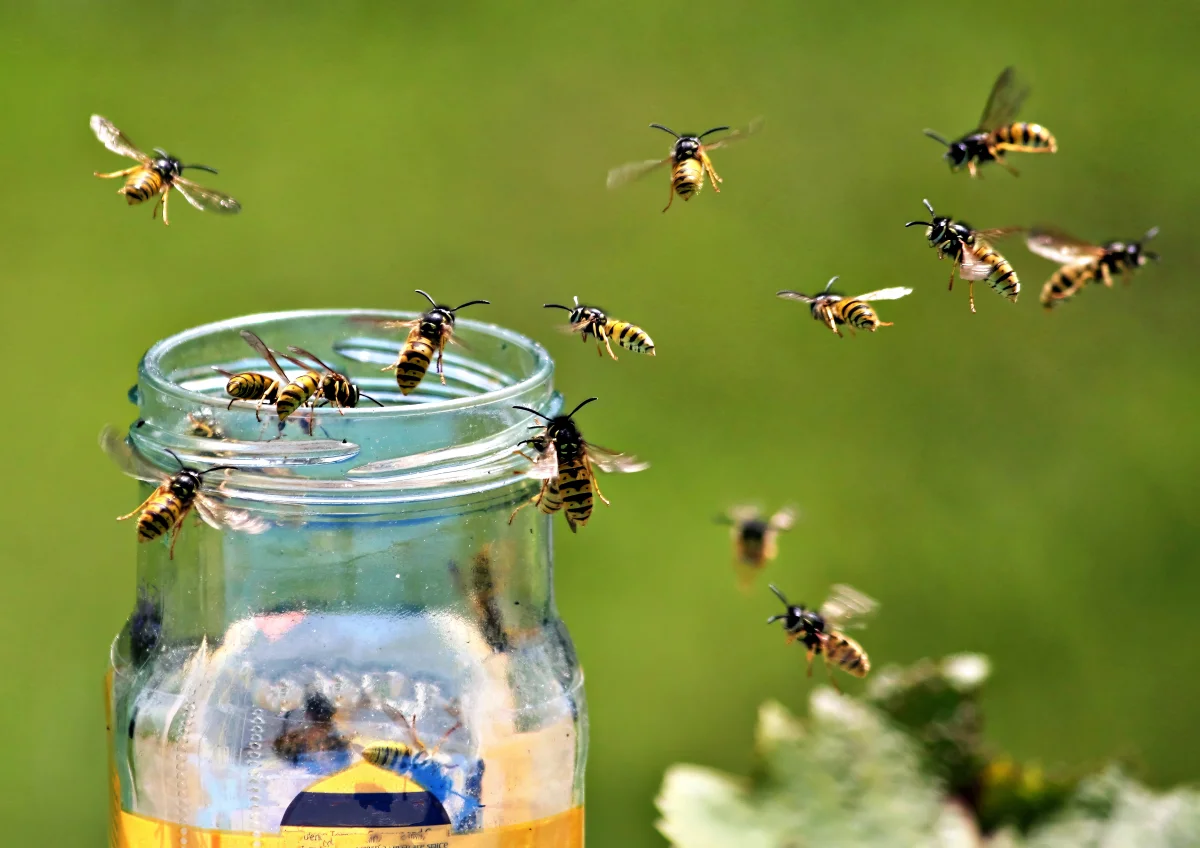
In June, a wasp at your table is a rare visitor. By August, it's a permanent one. A colony founded by a single female in May swells to several hundred hungry individuals by late summer — and every last one of them is heading straight for your watermelon, your juice, and your barbecue.
Wasps aren't humanity's enemy. They destroy harmful insects, participate in pollination, and generally prefer not to tangle with creatures larger than themselves. But by August their behavior shifts — and that's when the vast majority of painful, and sometimes fatally dangerous, stings occur.
The Life Cycle of a Wasp Colony
To understand why August is wasp month, you have to rewind to spring. In April–May, a single fertilized female emerges from hibernation — the future queen. She finds a sheltered spot — under a shed roof, in an attic, inside a tree hollow, sometimes right on an apartment balcony — and starts building a nest.
The construction material is paper, which the wasp manufactures herself by chewing wood fibers and binding them with saliva.
One egg per cell. The queen raises the first larvae on her own: catching flies and other insects, chewing them up, and carrying them to the nest. Within a few weeks, the first worker wasps emerge, and the queen switches exclusively to laying eggs.
By July, the nest has grown from a three-centimeter clump to 30–40 centimeters in diameter. Inside: already hundreds of individuals. By August, the colony hits maximum size, and every member is actively foraging.
Why Wasps Turn More Aggressive in August
Several reasons — and they stack on top of each other.
- Hunger
In spring and early summer, worker wasps are busy feeding larvae. Larvae need protein — flies, caterpillars, spiders. In return, adult wasps receive a sweet secretion from the larvae. By late summer, brood-rearing winds down, larvae become scarce, and workers lose their usual source of carbohydrates.
They switch to external sugar sources — fruit, jam, juice, lemonade, ice cream. Everything sitting on your table.
- Sheer Numbers
In June, a few dozen workers are flying around. In August — several hundred. The probability of a human encounter rises proportionally.
- Mating Season
In late summer, young queens and males appear in the nest. The colony is preparing to complete its cycle. Worker wasps become more nervous and excitable — any sudden movement near the nest is perceived as a threat.
Why a Wasp Is More Dangerous Than a Bee
A bee stings once and dies — its barbed stinger gets lodged in the skin. A wasp is a different matter. Its stinger is smooth, and a single wasp can sting multiple times in succession, injecting venom with every strike.
But there's a detail most people don't know. At the moment of a sting, the wasp releases an alarm pheromone that attracts other wasps. They fly toward the signal and sting the same spot. That's why multiple stings aren't a freak occurrence — they're a pattern.
"When one wasp stings, an alarm pheromone is released, effectively signaling other wasps — and they'll sting the very same location," explains Vladimir Ivanov, an entomologist at St. Petersburg State University.
How Dangerous a Wasp Sting Really Is
For most people, a wasp sting means pain, redness, and swelling that clear up in a few days. Unpleasant, but not dangerous.
The real threat is an allergic reaction. According to physicians, wasp venom acts as a powerful allergen in certain individuals. In severe cases, anaphylactic shock develops: blood pressure drops, airways swell, consciousness is lost. Without emergency intervention — fatal outcome.
Stings to the mouth, throat, and neck area are especially perilous. This can happen if you bite into a piece of fruit a wasp was sitting on, or take a sip from a juice can one has crawled into. Swelling in the larynx can block the airway within minutes.
How to Behave
The cardinal rule: don't wave your arms. A wasp interprets sudden movements as an attack and switches from "looking for food" mode to "defending myself" mode. Calmly step away, remove the food, cover your drinks.
A few practical rules for late summer:
- Don't drink from open cans or bottles outdoors — a wasp can crawl inside. Use glasses or bottles with lids.
- Don't walk barefoot on grass — wasps frequently sit on fallen fruit and flowers.
- Clear sweet items from the table immediately after eating. A cut watermelon, an open jar of jam, a glass of juice — all of it is a magnet.
- Don't place sweet traps near your seating area — they draw wasps toward you, not away from you.
- Bright clothing and perfume can attract attention — at a picnic, it's best to skip the fragrance.
If a Wasp Does Sting You
Wash the sting site with cold water, apply ice or a cold compress — this slows the spread of venom. Take an antihistamine. Don't scratch. Drink plenty of water.
If shortness of breath, dizziness, facial or throat swelling, or full-body hives appear — that's anaphylaxis. Call 103 or 112 immediately. People with a known allergy to Hymenoptera venom are advised by doctors to carry an epinephrine auto-injector — and to tell those around them where it is.
When Wasp Season Ends
By mid-September, the colony begins to die off. Worker wasps perish, the nest empties. The only survivors are young fertilized queens — they wedge themselves into cracks, under tree bark, into attic spaces, and fall asleep until spring. The following year, each one will start building a new nest — and the cycle repeats.