Kenya lies on the equator, but its weather varies more than you might expect: two rainy seasons, cool nights on the savannah and a hot, humid Indian Ocean coast. A month that's perfect for safari isn't always right for the beach, and vice versa.
The classic Kenya itinerary comes in two parts: a few days on safari in the Masai Mara and a week on the beach by the Indian Ocean. Many people plan it as a single trip, but the climate in these two places is quite different.
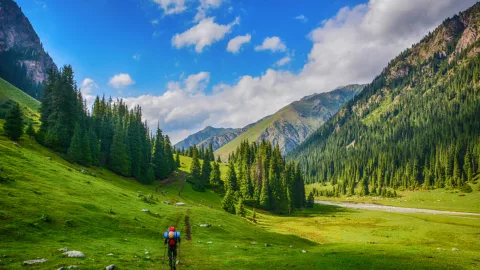
The Masai Mara savannah lies at an altitude of 1,400–2,100 metres: mornings here can be around 11°C, and days 25–28°C. On the coast at the same time, it's 28–33°C and very humid. The rains come in different months too. We look at how to combine safari and ocean without getting caught in downpours in either place.
Two Rainy Seasons
Kenya doesn't have winter and summer as we know them. The year is divided into dry and wet seasons, and there are two rainy seasons.
-
The long rains run from March to May. The wettest month in the Masai Mara is April (about 210 mm), and on the coast it's May (235–270 mm, with 14–19 rainy days). This is the worst time for both safari and the beach.
-
The short rains run roughly from October or November to December. On the savannah they're noticeable: the Masai Mara gets about 155 mm in November. On the coast, the short rains are lighter and vary a lot from year to year.
Between them come two dry periods: June to October and January to February. These are the ones to aim for.
When to Go on Safari
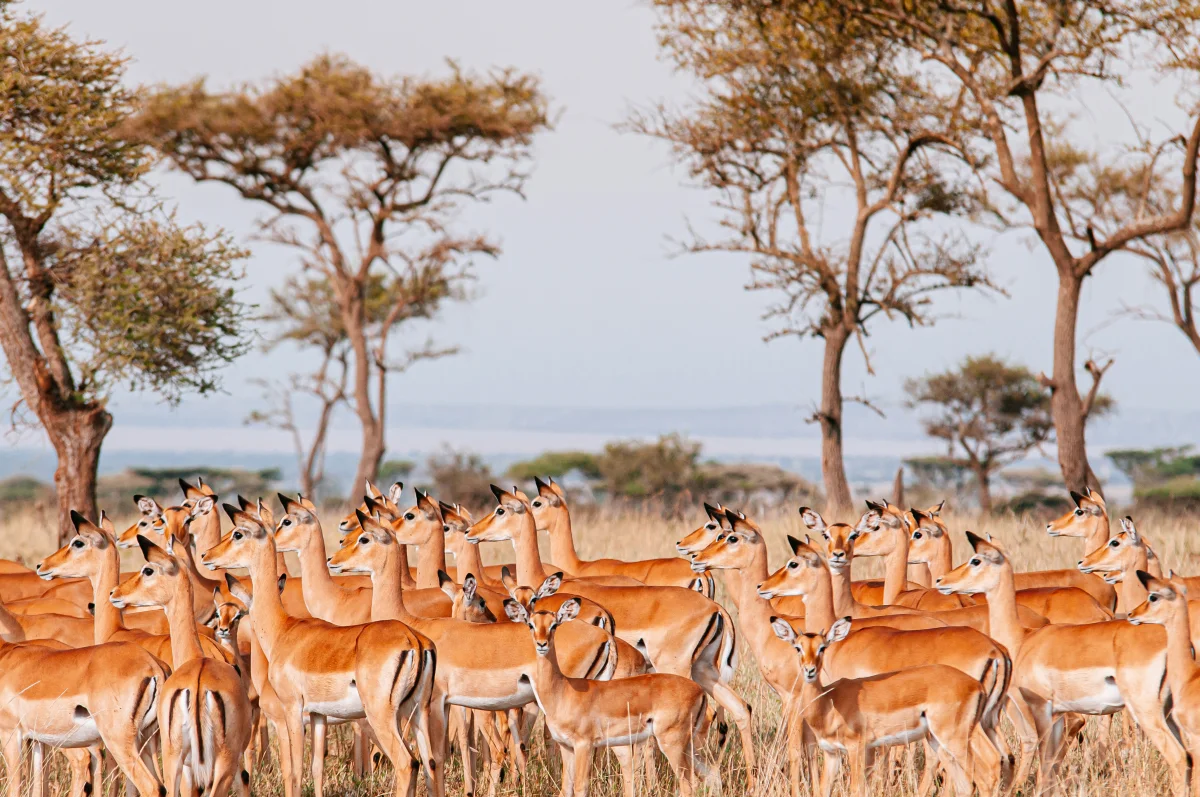
July to October is Kenya's main safari season, above all because of the Great Migration. This is the annual movement of enormous herds, around 1.5 million wildebeest, 200,000–300,000 zebras and hundreds of thousands of gazelles, between Tanzania's Serengeti and Kenya's Masai Mara. The herds arrive in Kenya around July and leave in October.
The most famous spectacle of the migration is the crossings of the Mara River, where wildebeest plunge into the water by the thousand under the noses of crocodiles.
The crossings usually peak in August and September. But this isn't a single event with a fixed date: the crossings recur over several weeks, and the timing of the migration shifts every year depending on the rains. No guide can guarantee a crossing on a particular day.
These months are also dry in the Masai Mara: July is the driest month, with about 60 mm of rain. The nights are cool: from June to August the temperature drops to 11–12°C, and sometimes below 10°C. A warm jacket for early-morning drives in an open jeep is essential.
January and February are the second good window for safari. This is a short, relatively dry and warm period, with daytime temperatures of 28°C. There's no migration in Kenya at this time: the herds move to the southern Serengeti, where mass calving begins. But the animals that live on the savannah all year round stay put, and the Masai Mara entry fee is half the price.
From March to May, the long rains hit the savannah, and the reserve's dirt roads turn into slippery mud. Safari is possible at this time, but your trip will be dictated by the weather and the state of the roads.
How Much Entry to the Masai Mara Costs
The reserve's entry fee is set by the Narok County government, and for foreigners it depends on the season. From July 1, 2026, the summer rate was doubled:
-
January 1 to June 30: $100 per adult per day.
-
July 1 to December 31: $200 per adult per day.
-
Children aged 9–17: $50 all year round; under-8s go free.
The same rates apply in the Mara Triangle (entered via the Oloololo and Purungat gates). The private conservancies around the Mara have their own fees, usually around $60–80 a day, and these are often already included in the price of the camp.
A ticket is valid for about 12 hours, roughly from 6am to 6pm, rather than a full day: if you leave and come back later, you'll have to pay again. The seasonal rate is set by your date of entry. Cash is gradually being phased out at the entrances to Kenya's parks, so it's best to check how to pay with your camp or guide in advance. The county can change its rates at short notice, so check the 2027 fees when you book.
When to Go to the Coast
Kenya's coast (Mombasa, Diani, Watamu and Malindi) is warm all year round, but it isn't always comfortable.
January to March is the best time for a classic beach holiday. It's the driest period: in February, Mombasa averages just one to four rainy days. Daytime temperatures are 32–33°C, nights 23–24°C, and the sea is 28–29°C. It's hot and humid, but sea and sunshine are guaranteed.
April and May are the peak of the long rains. In May, Mombasa gets more than 230 mm of rain, with only six to six and a half hours of sunshine a day on average. In heavy seasons, downpours cause flooding and power cuts. This is a time to skip the beach.
June to September is the cool season on the coast. Daytime temperatures are 28–29°C, nights around 20°C, and the sea cools to 25–26°C. The south-east trade wind blows in off the sea, so the coast is often windy in these months. This is kitesurfing season.
October to December is a transitional period. The short rains on the coast are usually light, the sea warms up again to 27–28°C, and by December there's less rain.
How to Combine Safari and Beach
There are two periods when conditions are good both on the savannah and on the coast.
January to February. It's dry in both places, the ocean is at its warmest, 28°C and above, and entry to the Masai Mara costs $100 rather than $200. The downside is that there's no migration in Kenya: at this time it's seen in Tanzania.
July to September. The peak of the migration and the river crossings in the Masai Mara, and a dry savannah. On the coast it's cooler and windier at this time, the sea 25–26°C: you can swim, but it's not the tropical "bath" of the January ocean. And safaris are at their most expensive in these months.
October is a compromise. The migration may still be in the Mara, the coast is warm and the rains are still light, but on the savannah the short rains may begin towards the end of the month.
What to Know Before You Go
Since 2024, Kenya has abolished visas for foreign visitors and replaced them with an electronic travel authorisation, the eTA. Russians need to apply for one online in advance on the official website: applications can be made up to 90 days before arrival and no later than three days before, but a week ahead is better. The fee is about $32.50. Your passport must be valid for at least six months.
There are no direct flights from Russia to Kenya. You'll need to change planes in Istanbul, Addis Ababa or the Gulf states.
In 2026, connections via the UAE were disrupted more than once because of airspace closures in the Middle East, so check schedules before buying tickets.
For safari, pack a warm jumper and a windproof jacket for morning and evening drives: it can be around 10°C on the savannah at those times, and the jeeps are usually open. For the coast, bring sun protection: on the equator, the sun is strong even on a cloudy day.