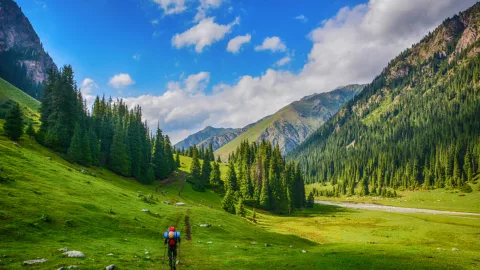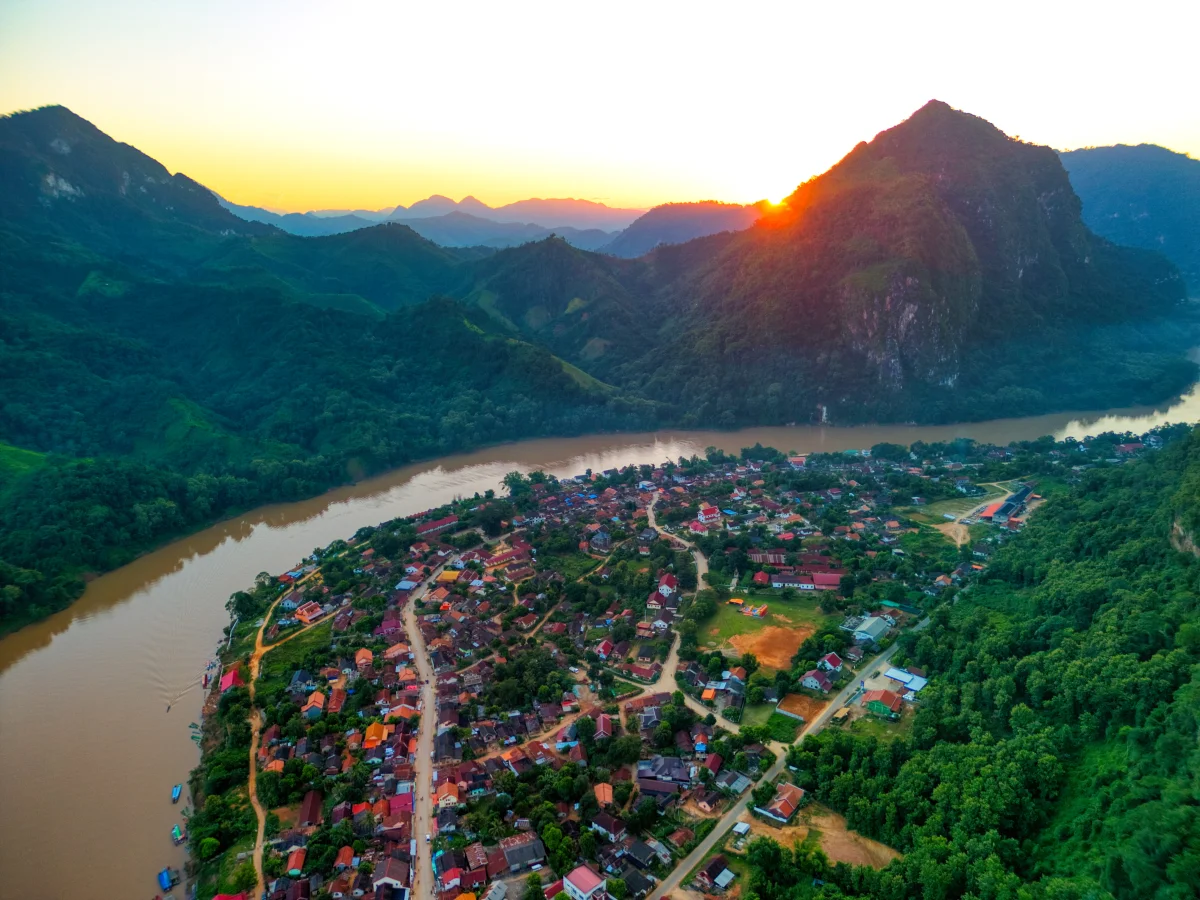
Laos has two kinds of "bad" weather, and both can spoil a trip: downpours in summer and haze from burning fields in spring. The window between them isn't very wide, but during those weeks the country looks exactly the way people travel there to see it.
Photographs of Luang Prabang usually look the same: the golden roofs of monasteries, green mountains above the Mekong and the orange robes of monks on the street in the early morning. But if you come here in April, you may find a very different picture: the mountains dissolve into a grey veil, the sun hangs like a pale disc, and sunset over the river looks more like dusk in smog.
This isn't fog or cloud: it's smoke. Every spring, fields and dry grass are burned across Laos. And in summer, the haze gives way to monsoon downpours. We look at when Laos looks the way it does in the photos.
The Three Seasons of Laos
The weather in Laos is governed by the monsoon, and the year divides into three periods.
-
The cool dry season — from November to February. There's almost no rain, daytime temperatures are 27–31°C, and the nights are cool. The best time to visit.
-
The hot dry season — from March to May. Temperatures rise to 35°C during the day, and in low-lying areas they can reach 40–42°C. This is also haze season: from February to April, fields are burned in the north.
-
The rainy season — from May to mid-October. It peaks in July and August, with 20–21 rainy days a month and up to 300–340 mm of rain in Vientiane and Luang Prabang.
The Weather Month by Month
Below are average daytime and night-time temperatures and the number of rainy days in Luang Prabang (in the north, 300 metres above sea level) and Vientiane (the capital, 175 metres).
-
November — Luang Prabang: 30°C by day, 18°C at night, 3 rainy days; Vientiane: 31°C/22°C, 2 days. The rain is ending, the countryside is still green after the monsoon, and the air is clear.
-
December — Luang Prabang: 27°C/15°C, 2 rainy days; Vientiane: 29°C/19°C, 1 day. The most comfortable weather of the year.
-
January — Luang Prabang: 28°C/15°C, 2 days; Vientiane: 29°C/18°C, 2 days. Nights in the north are cool, sometimes dropping to 10°C or below, and there are often morning mists.
-
February — Luang Prabang: 32°C/15°C, 1 rainy day. It's already hot during the day, and by the end of the month smoke starts to appear in the air.
-
March — Luang Prabang: 34°C/18°C; Vientiane: 33°C/22°C. Dry and hot, but one of the worst months for air quality.
-
April — The hottest month, at 35°C by day, with 9 rainy days in Luang Prabang. The peak of the haze.
-
May — 34–35°C, and the rains begin, with 14–15 rainy days a month.
-
June–September — 31–34°C by day and 23–25°C at night. In July and August it rains on 20–21 days a month.
-
October — 32°C, with noticeably less rain, on 7–8 days. The end of the monsoon.
What the Haze Is and Where It Comes From
In spring, a thick blanket of smoke hangs over Laos and its neighbours. Its main cause is slash-and-burn agriculture: before planting, farmers burn their fields and patches of forest. On top of that comes the burning of dry grass to create pasture, forest fires, and smoke carried in on the wind from neighbouring countries, including northern Thailand.
The scale is enormous.
According to Laos's Ministry of Agriculture and Environment, 16,395 fires were recorded in the country in the first three months of 2026, and on April 10 the daily number reached 2,288. On April 14, the air quality index (AQI) in Luang Prabang reached about 240, in Vientiane more than 180, and in Houaphanh Province it exceeded 280.
Values above 150 are considered unhealthy for everyone, and above 200 "very unhealthy".
The north suffers most from the haze: Luang Prabang, Vang Vieng, Nong Khiaw, Oudomxay, Bokeo and Houaphanh. In the south, in Pakse and on the Bolaven Plateau, the air is usually cleaner, although the haze reaches there too.
What the Haze Means for Travellers
Even leaving health aside, the spring haze literally swallows up the scenery. Vang Vieng's famous karst cliffs disappear into a grey veil, visibility from viewpoints is just a few hundred metres, and photos come out brown and blurry. What's the point of going to the mountainous north of Laos if you can't see the mountains?
The smoky season usually lasts from February to April, and in bad years it stretches from January to May. It ends when the monsoon rains arrive and wash the smoke out of the air. But then another problem begins: the downpours.
North and South: The Difference Is Greater Than It Seems
Laos stretches almost a thousand kilometres from north to south, and the weather varies between different parts of the country.
The north (Luang Prabang, Nong Khiaw and Luang Namtha) is cooler in winter. In December and January, night-time temperatures here are around 15°C, and it can be even colder in the mountains. In January 2016, snow even fell in the northern provinces at altitudes above 900 metres.
A warm jumper and a windproof jacket are well worth packing for northern Laos in winter.
The south (Pakse, the Bolaven Plateau and the Si Phan Don islands) is hotter and drier in winter: in December and January, Pakse gets 0 mm of rain, with daytime temperatures of 32°C. In summer, though, the south gets the most rain of all: in August, Pakse receives 505 mm, with rain on 25 days out of 31.
When to Go: The Window Without Rain or Smoke
If you want Laos without downpours and without haze, the time to go is November to January. In November the rains have ended, but the fields aren't being burned yet. December and January bring the driest, clearest and most comfortable weather of the year. Many guidebooks name mid-December to the end of January as the best time.
February is a borderline month. It's still good at the start, but haze may set in by the end, especially in the north. March and April are the worst time for northern Laos, although the south is more bearable then.
Don't write off the rainy season entirely, though. The countryside is at its greenest, and there are usually fewer tourists. But in July and August it rains almost every day, and you'll have to plan your trip around the weather.
How to Get There and What You Need to Know
Russians don't need a visa: you can stay in Laos for up to 30 days per entry without one. Your passport must be valid for at least six months.
Since September 1, 2025, anyone entering through the airports in Vientiane, Luang Prabang or Pakse, or across the First Thai–Lao Friendship Bridge between Vientiane and Nong Khai, has had to fill in a free electronic form, the LDIF (Lao Digital Immigration Form), on the official website. It can be completed no earlier than three days before you cross the border, and separately for entry and exit.
In 2026, the system was due to be extended to all international border crossings. It's best to save the QR code as a screenshot.
There are no direct flights from Russia to Laos in 2026: the two sides discussed the need to launch them during talks in June 2026, but no decision has been taken yet. Travellers usually fly with a connection in China or Thailand.
Within the country, the most convenient way to get around is the high-speed train linking Vientiane, Vang Vieng and Luang Prabang. It takes about one hour to Vang Vieng and about two hours to Luang Prabang. From April 1, 2026, a first-class ticket to Luang Prabang costs 569,000 kip (about $26), and second class 360,000 kip (about $16). Tickets sell out quickly, so it's best to buy them as soon as sales open.
Russian Visa and Mastercard cards don't work. It's safer to bring cash in dollars and change it into kip locally.
And a tip for those who do travel in spring: keep an eye on the air quality index in an app such as IQAir, and plan your outings for days when it's lower. The air is usually cleaner in the south, so in spring it's better to shift your route there. And if the haze catches you in Luang Prabang, an ordinary surgical mask won't help: only N95 or FFP2 respirators filter out fine smoke particles.