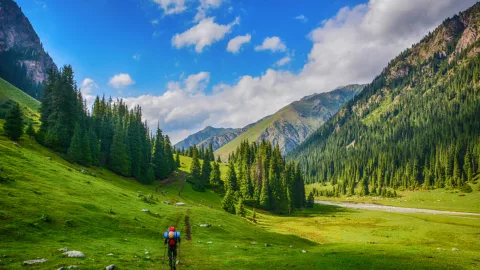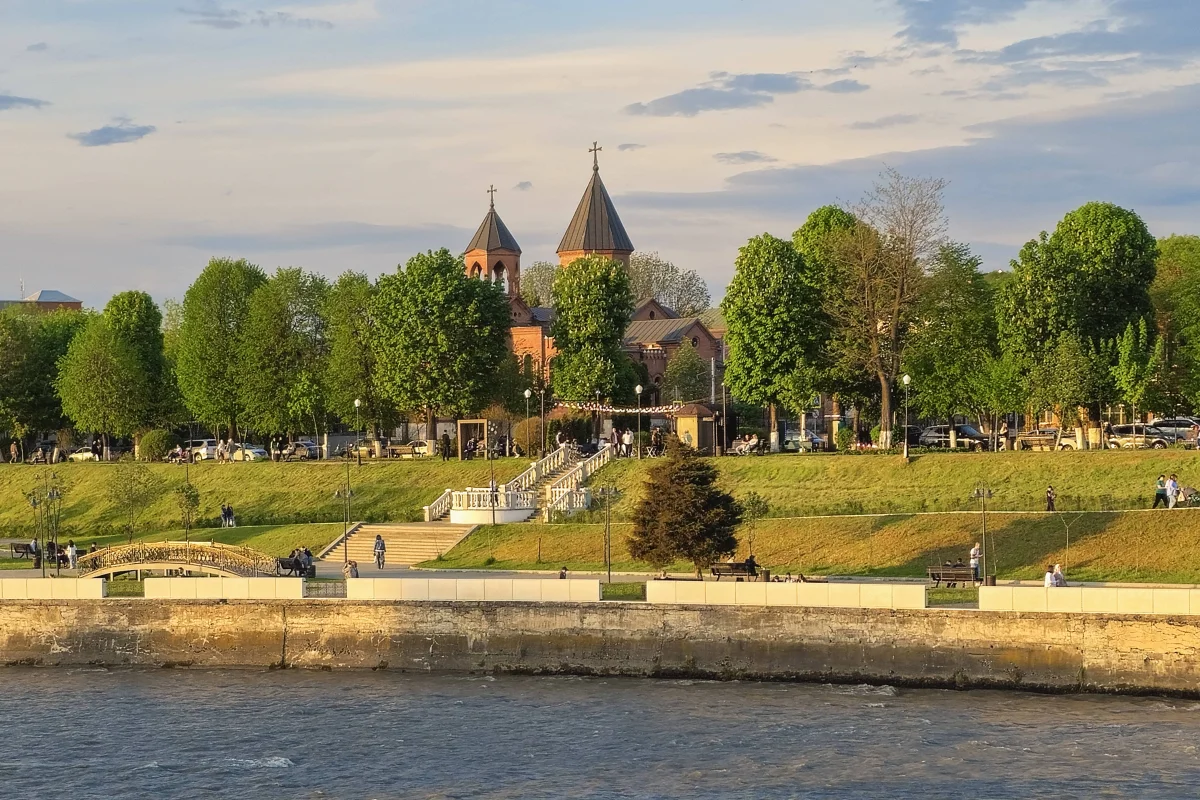
People visit North Ossetia all year round: in spring for the waterfalls, in summer for hiking and in winter for skiing. But there are a couple of weeks when the gorges look so spectacular that people back home won't believe the photos were taken in Russia.
On a clear morning in Vladikavkaz, you can pop out for an Ossetian pie and see the white summit of Mount Kazbek 5,033 metres high towering over the city. The real mountains are an hour's drive away, and tourists have long since worked this out.
In the first nine months of 2025, according to mobile operators, the republic received 450,000 visitors, almost twice as many as a year earlier. The peaks come in April and July. But the most beautiful time for Ossetia is not these months.
Spring: Water and Greenery
From April, daytime temperatures in Vladikavkaz reach 15–18°C, and by May they're already around 20°C. In the foothills everything is in bloom, and the rivers fill up with meltwater from the glaciers. By May, the gorges turn bright green.
The downside of spring is that it arrives later in the mountains. There's still snow on the high trails, and in April it often rains in the valleys.
Spring in Ossetia is good for road trips through the gorges, but not for serious hiking.
Summer: Hiking Season
In summer, daytime temperatures in Vladikavkaz average around 26°C, and rarely go above 28°C. In the mountains it's 5–15 degrees cooler, so you'll need a jacket even in July. Thunderstorms often build up in the afternoon, so it's best to set off on a trail early in the morning.
The best period for trekking is July to September. In June there are still patches of snow on the high passes, and by July all the high-altitude routes are open. The trails of the Alania National Park are open in the warm season, and entry costs 250 roubles. Here you'll find, for example, the Three Sisters waterfalls, which plunge from the Taymazi massif, about 300 metres high, and the five-tiered Galdoridon, about 35 metres high.
Autumn: Those Two Weeks
If you had to pick one time when the mountains of Ossetia look their most striking, it would be the first half of October. The most reliable period for golden autumn colours is roughly October 1 to 15, and in good years the colours last until the 20th.
These are the days when you get a view you won't see in summer: slopes of yellow, orange and red, with fresh snow already lying on the peaks above them. What's more, autumn moves down the mountains from the top: first the high mountains turn yellow, then the middle slopes, and only at the end the foothills and Vladikavkaz itself.
So at the start of October it's worth heading higher for the brightest colours, and towards the end of the month into the lower gorges.
The best places for golden autumn colours:
-
The Digor Gorge — the furthest and most picturesque option. Here you'll find the narrow Akhsinta Canyon, just a few metres wide in places, and the Devil's Bridge high above the river.
-
The Tsey Gorge — pine forests on the slopes give way to glaciers, and you can ride a cable car up towards the Skazsky Glacier.
-
The Kurtatin Gorge and the upper Fiagdon valley — with the Kadargavan Canyon, where the walls almost touch, and medieval towers on the slopes.
Autumn has its limitations. At night in Vladikavkaz in October, it's already 4–6°C, and at around 2,000 metres the daytime temperature may be no higher than 5°C. After October 20, snow, ice and fog are common in the mountains, and some routes effectively switch to winter mode. A single windy day can strip all the leaves from the trees, so it's worth leaving a spare day in your itinerary.
Winter: Tsey and the New Mamison
From December to April, people ski in Ossetia. The republic's oldest resort is Tsey, in the gorge of the same name, about 90–100 km from Vladikavkaz. Snow usually settles here in late October or early November, and a stable winter for skiing sets in by the end of December.
The big news of recent years is the Mamison resort in the Alagir district, which opened on March 14, 2025. Its first full season began on December 31, 2025 and lasted 132 days. During that time, the resort received more than 35,000 visitors, and the length of its pistes grew to 19 km.
At the opening, the head of the republic, Sergei Menyaylo, said he was confident that Mamison would become one of the best year-round ski resorts in the country.
At launch, in March 2025, a day pass at Mamison cost 2,400 roubles for adults and 1,500 roubles for children. It's best to check prices for the new season on the resort's website. Bear the off-season in mind too: in 2026, Mamison's lifts were closed for scheduled maintenance from September 28, and from October 17 they reopened for sightseeing until the start of the ski season.
What to See at Any Time of Year
Many of Ossetia's main sights are worth visiting in any season; you just need to factor in the roads.
-
Dargavs, the "City of the Dead" — a necropolis of 95 crypts on the slope of the Dargavs Gorge. There's an entry fee (about 100–150 roubles). The final stretch of road is a steep mountain serpentine, so it's best to go with an experienced driver.
-
The Karmadon Gorge — a road along the Genaldon River to the Kolka and Maili glaciers. This is also the site of a memorial to the Kolka glacier collapse of 2002, which killed the film crew of Sergei Bodrov.
-
The Midagrabin Waterfalls — the highest of them, Big Zeygalan, falls about 600 metres. The route passes through a border zone: your passport is essential, and you should check in advance whether you need a separate permit, which is issued by the FSB border directorate, including via Gosuslugi, and takes up to 15 working days. The waterfalls carry the most water in July–August, and in the cold season only two or three of them are flowing.
-
The Alan Assumption Monastery in Khidikus, 55 km from Vladikavkaz, which stands above the Alagir Gorge on a cliff by the Ardon River.
How to Get There and Where to Stay
The flight from Moscow to Vladikavkaz takes about 3 hours 15 minutes, and almost 4 hours from St Petersburg. The airport is in Beslan, 26 km from the city. The train from Moscow takes about 37 hours, and by car it's about 1,800 km to Vladikavkaz via the M4 highway.
It's most convenient to stay in Vladikavkaz and head to a different gorge each day: that makes it easier to change your plans according to the weather. If you'd like to be closer to the mountains, you can stay in Alagir, where a flat costs roughly 2,500–3,000 roubles a night.
Before You Head Into the Mountains
-
Check the forecast for the specific gorge, not for Vladikavkaz. A difference of 10 degrees, and in the weather generally, is common here: it can be sunny in the city while there's fog and snow on the pass.
-
Bring cash. In Vladikavkaz, cards and the Faster Payments System (SBP) are accepted everywhere, but in the mountains card terminals often don't work and there are hardly any cash machines. Withdraw money in the city, in Beslan or in Alagir.
-
Download offline maps. Outside the villages, mobile coverage disappears, and a navigation app without internet access is useless in a gorge.
One more small thing that visitors only find out on the spot: Ossetian pies near popular sights usually cost noticeably more, sometimes two or three times as much as the same potato pie in Vladikavkaz or Alagir. It's better to buy snacks in town beforehand.