Serbia is one of the few European destinations that Russians can still fly to directly and without a visa. But choosing when to go is trickier than it looks: the country has no sea, but it does have mountains, thermal spas, river beaches and festivals, and each has its own season.
Belgrade in July means 33°C in the shade, scorching tarmac and a packed Ada Ciganlija, where half the city heads for a breath of cool river air. Belgrade in October is a different city: warm evenings in Skadarlija, autumn leaves in Kalemegdan, and the chance to walk all day without hiding from the sun.
And in January it's another Serbia altogether: Kopaonik is buried in snow, and steam rises from the thermal pools of Vrnjačka Banja while it's below freezing outside. The question isn't when to go, but why, and then choosing the month to match.
What Serbia's Climate Is Like
Serbia is a landlocked continental country, and its climate shows it. Winters are cold and summers hot: the average temperature in Belgrade is around 0°C in January and about 22°C in July, a difference of more than 20 degrees.
In Belgrade, which is a good guide for the lowlands, the average annual temperature is around 12°C. In winter, daytime temperatures hover around 4–7°C and drop below freezing at night. In summer, days are 27–29°C, rising to 33–35°C during heatwaves.
The country gets around 700 mm of rain a year, spread fairly evenly: the most in May and June, the least in August to October. There are around 2,000–2,100 hours of sunshine a year, most of them between May and September: in July and August the sun shines for about ten hours a day, but in December and January for just two to two and a half.
In the mountains (Kopaonik, Zlatibor and Tara) it's 5–8 degrees cooler, and at high altitudes the snow lasts for most of the winter. In the south, towards Kosovo and Niš, summers are drier and hotter.
Spring: April and May, for Cities and Nature
Spring in Serbia is the season when everything turns green at speed, while there are still few tourists. April already brings a comfortable 17–21°C by day; summer terraces open, and chestnut trees and lilac bloom in the parks.
May is one of the best months for a first trip. It's warm (22–25°C), the days are long and the mountains are green.
It's the ideal time for Tara and Đerdap national parks: the trails are dry, the rivers are full after the snowmelt, and the Danube through the Iron Gates offers spectacular views without the July heat. Fruška Gora, near Novi Sad, is covered in flowering meadows, and its monasteries look especially photogenic amid the greenery.
The downside is May thunderstorms: May and June are the wettest months of the year. The downpours can be short but powerful, so an umbrella and a waterproof jacket are essential, even if the sun is shining in the morning.
Summer: Heat, Rivers and Festivals
June to August is the hottest time of year, and you need to be ready for it. In Belgrade and on the plains of Vojvodina, daytime temperatures regularly reach 30–33°C, and sometimes higher. For anyone who struggles with heat, long walks around the city become an ordeal.
But it's in summer that Serbia offers something you wouldn't expect: river beaches. Belgrade's main spot for swimming is Ada Ciganlija, a peninsula on the Sava River. Between two dams, a lake 4 km long has formed, with a pebble beach stretching almost 7 km.
At the height of the season, up to 100,000 people a day come here: it's essentially an urban resort with sports grounds, cafés and water activities. The swimming season at Ada runs from mid-June to the end of September.
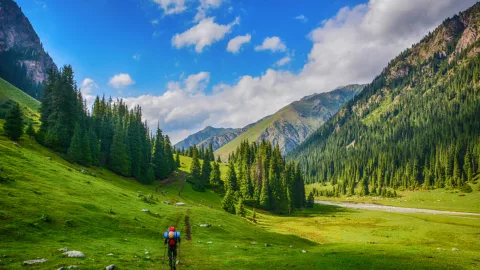
In summer, the mountains offer an escape from the heat. On Zlatibor and Tara, even in July, daytime temperatures are 22–26°C, and you can sleep without air conditioning at night. The Uvac canyon, with its viewpoints and colonies of griffon vultures, is open from May to October, but boat trips depend on the water level.
Festival Season
Summer is the time for Serbia's biggest festivals. The trumpet festival in Guča is an event that draws visitors from all over the world to a small town in the Dragačevo region. It takes place in August (usually in the middle of the month) and lasts several days, with tens of thousands of people turning up on the peak days.
It's Balkan brass, pork roasted over charcoal and an atmosphere that can't be described, only experienced. Check the exact dates on the festival's website.
As for the famous EXIT, the biggest music festival in the Balkans, which was held for 25 years at Petrovaradin Fortress in Novi Sad, it left Serbia in 2026. The organisers set off on a world tour after pressure from the authorities over the festival's support for student protests. The tour is due to end in November 2026 in Belgrade with the No Sleep festival, but there was no classic summer EXIT at Petrovaradin this year.
Autumn: September and October, the Golden Time
If you had to name one best month to visit Serbia, it would be September. Daytime temperatures are 23–27°C: the heat eases, but the warmth remains. There are noticeably fewer rainy days than in spring: in Belgrade, September is one of the driest months of the year.
October brings a mild autumn with vivid foliage: 16–21°C, still warm enough to go without a jacket during the day. The Tara mountains and Fruška Gora turn gold and crimson, making it the perfect time for photography and hiking.
Autumn is also the season of wine and food. Fruška Gora and the area around Sremski Karlovci host wine fairs, and Šumadija and Negotin hold harvest festivals. Serbian wines, above all the indigenous Prokupac and Tamjanika grapes, are well worth getting to know, and autumn is the perfect excuse.
November is already grey and rainy: the days are short and the mood changes. It's still bearable for exploring cities, but too late for nature and the mountains.
Winter: Skiing and Thermal Spas
Winter in Serbia comes in two versions: a ski resort or a thermal spa. Or you can do both in one trip.
Kopaonik is the country's main ski resort. Its highest point is Pančić's Peak (2,017 m), with about 55 km of runs and 25–26 lifts.
The season usually runs from early December to early April (in 2026/27 the opening is scheduled for December 3), and the most reliable time for skiing is January and February, when the snow cover is deepest.
The resort is compact, and the runs are best suited to beginners and intermediates: for experienced skiers used to the Alps the scale will feel modest, but prices are noticeably lower.
Zlatibor, with its Tornik ski centre, is the second most popular winter resort and more geared towards families. Stara Planina and Divčibare are options for those looking for something more intimate.
Thermal Spas
Serbia has more than 1,000 thermal springs, putting it among Europe's leaders in terms of their density. They're open all year round but are especially good in winter: it's below freezing outside, and you're sitting in an open-air pool with the water at 36–38°C.
- Vrnjačka Banja is the best-known spa resort, with four types of mineral water. The town feels like a 19th-century European spa, with parks, promenades and pump rooms.
- Sokobanja: eastern Serbia, mountain air and thermal pools with views of the ridge.
- Vrdnik (Fruška Gora) is convenient if you're combining it with a trip to Novi Sad.
Getting There From Russia
Serbia is one of the most accessible European destinations for Russians. Direct flights to Belgrade are operated by Air Serbia from Moscow, St Petersburg, Kazan, Sochi and Nizhny Novgorod (the last route opened in May 2026). In addition, in October 2026 the two sides agreed on regular flights by the Serbian airline to Kaliningrad.
In the first half of 2026, Russians took first place in the number of visits to Serbia. To put that in perspective, around 174,000 Russian tourists visited the country in the whole of 2025, roughly 7–8% of all tourist arrivals.
In 2027, Serbia will host the international EXPO exhibition, which is forecast to give tourism a significant boost.
Visas
Russians don't need a visa: under a 2009 agreement, they can stay in the country for up to 30 days per visit. The visa question comes up regularly: aligning visa policy is one of the EU's conditions for candidate countries, and Serbia's Foreign Ministry had previously announced plans to bring its visa policy into line with Europe's by the end of 2026.
But in June 2026, Serbian President Aleksandar Vučić called reports of visas being introduced for Russians disinformation and said no such decision would be taken, and the European integration minister confirmed that the issue is not currently under consideration. Still, it's worth checking the current rules before you travel.
As for formalities, you may be asked for a return ticket and proof of accommodation on entry, and it's advisable to take out medical insurance in advance.
You need to register your place of stay within 24 hours: hotels do this automatically, but if you're renting a flat, you'll have to go to the police or use the euprava.gov.rs portal.
Which Month to Choose
- April and May: for exploring Belgrade and Novi Sad and visiting national parks and fortresses. Warm, green and uncrowded.
- June: already hot, but still bearable. Good for combining cities and nature. Ada Ciganlija opens its swimming season.
- July and August: for those going for the festivals (Guča) and ready for the heat. Comfortable in the mountains, a matter of survival in the cities.
- September: perhaps the best month of the year. Warm without being hot, dry, with wine and food festivals.
- October: a mild autumn with golden foliage. The last chance for warm, jacket-free weather.
- December to February: skiing on Kopaonik, thermal spas, and winter Belgrade with its Christmas markets.
Serbia is a country that doesn't shout about itself but knows how to surprise you at any time of year. The key is not to try to cram everything into one trip, and to choose the season to suit a specific idea: mountains, rivers, wine or snow.