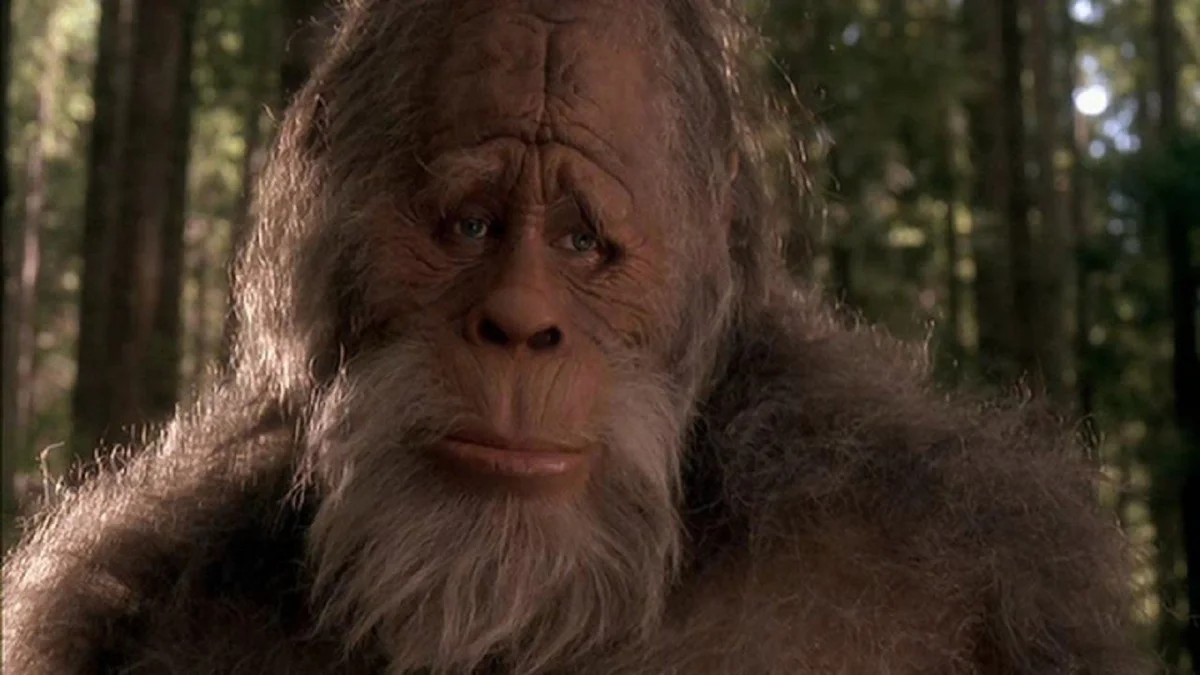
Historical sources indicate that people began talking about Bigfoot as far back as the 19th century. But the first official report published in a periodical appeared in 1958.
Bigfoot has long been considered a combination of folklore, misidentification and even hoaxes. But one thing can be said for certain: to this day it remains genuinely unknown whether it exists. And if it does exist, who or what this creature actually is. Scientists have conducted research and studied possible evidence and traces.
In 1967, researchers Bob Gimlin and Roger Patterson became the authors of that famous footage – the only proof that the yeti exists. They filmed a huge figure covered in thick fur in the Six Rivers National Forest, northern California.
The video, known as the Patterson-Gimlin film, became the starting point for studying the mystery of Bigfoot. In all, scientists have put forward five main theories.
Bigfoot — an extinct species of hominid
Ten years ago, research by Melba S. Ketchum showed that genetic testing confirmed Bigfoot to be a relative of humans. That is, it belongs to the family of primates and great apes.
«Our data show that the North American Bigfoot is a hybrid species, the result of crossbreeding males of an unknown hominid species with female Homo sapiens», — states Ketchum's report.
It took Ketchum and her colleagues five years to study 111 samples of alleged hair, blood, mucus, toenails, bark scrapings, saliva and skin, which had been collected at more than 30 locations across North America.
Some of them did not match human hair or that of any known wild animal after comparison with the fur of dogs, cows, horses, deer, elk, foxes, bears, coyotes and wolves.
The report also claimed that DNA analysis revealed two completely different types of results; the mitochondrial DNA unambiguously belonged to a human, while the nuclear DNA contained a new structure and sequence. The data prove that Bigfoot is an existing hominid and is a direct descendant of modern humans on the maternal side.
However, critics of this theory later explained that any of these samples could have been contaminated and therefore produced erroneous results. Moreover, human DNA could have ended up on a sample even from being touched by the scientists during the research.
And, finally, doubt was cast on the journal in which the study was published. Not only had no one heard of it, but it also turned out that no other studies, articles or reviews had been published in it. Ketchum was the only one. But the scientist explained that no scientific publication had been willing to publish her report, so she had to create one herself – for a single publication.
The yeti – an ancient ape that survived the ice age

Other scientists believe that Bigfoot is actually the ancient giant ape Gigantopithecus blacki from South Asia, which wandered into North America. As the researchers explain, about two million years ago an ape the size of a polar bear lived in Asia. They are considered extinct. But it is possible that a few individuals survived and produced offspring.
Gigantopithecus lived in the territory of present-day China, India and Vietnam. They stood up to a maximum of three meters tall, weighed 600 kg and fed on vegetables and fruit. Gigantopithecus required an enormous amount of energy to survive. Food became scarce when, about 100,000 years ago, its forest habitat turned into savanna. Its inability to adapt led to its disappearance. That is why scientists believe the beast may have wandered into North America during the ice age, trying to find a more suitable region in which to thrive.
Bigfoot – not the only one
According to some researchers, the yeti does not live alone. Most likely, it is a member of a large tribe whose number of kin may reach up to 2,000. That is, that many monsters may be living in the forests of North America. This explains why the yeti has been seen in almost every state.
After all, for the yeti to be viable, its population must be large enough to avoid extinction.
The yeti – a spirit of nature

More precisely, a creature from Native American mythology. And «yeti» is just one of more than 50 names given to this monster. Esotericists consider it a non-physical beast.
The fact that Native Americans may have worshipped Bigfoot is evidenced by a rock pictograph drawn 1,000 years ago. Ancient drawings depicting a hairy figure were found in the Tule River Indian Reservation in California.
Some Native American tribes claimed they had seen Bigfoot transform into a nature spirit – a wolf, for example. And others believed that these creatures possess extrasensory abilities.
It has also been suggested that the so-called Bigfoot is visible to some people but invisible to others. Another legend holds that it lives in another dimension but can make itself visible at will.
By the way, Native Americans believe that to see Bigfoot is a blessing and a sign of good luck.
Bigfoot – just a joke and a hoax
.jpg)
Most scientists lean toward precisely this boring but most likely version. Especially since many of the photo and video proofs really did turn out to be fakes. For example, in 1958 the journalist Andrew Genzoli of the Humboldt Times drew attention to an interesting reader's letter about loggers in northern California who had discovered mysteriously large footprints. The interest was so unexpected that Genzoli then published a series of follow-up articles, including one about how the loggers had named the so-called creature that left the tracks «Bigfoot».
As it turned out, the footprints were actually left by a man named Ray Wallace. His hoax was exposed after his death in 2002 – Wallace's children admitted that it had all been just a joke.
In October 2013, yet another «photographic proof» of Bigfoot in Pennsylvania was declared a fraud after the mythical creature turned out to be a huge tree stump.
Even the famous Patterson-Gimlin video was called into question – researchers believe it shows a man in a fur suit. At the same time, many supporters of the recording say they have studied the creature's gait and confirmed that it was not a human, adding that no special effects in 1967 could have created such a natural ape-like creature.
So for now, the existence of Bigfoot remains a bone of contention in the scientific world.
Was there ever a yeti? A researcher from the US unravels the mystery of Bigfoot