You step off the plane, and the air hits your face like an open oven door. Or, alternatively, it wraps around you with a pleasant warmth — it all depends on which month you landed in. Those first few minutes in Dubai decide a lot. Get it wrong, and you'll spend the week shuttling from one air-conditioned room to the next.
Dubai is a city that doesn't leave anyone indifferent. You can love it, or dismiss it as a giant shopping mall in the middle of a desert, but you can't come away unimpressed.
The tallest skyscraper on the planet, artificial islands shaped like a palm tree, a ski slope inside a mall while it's 113°F outside — everything here is built on contrast with nature. And that's precisely why the weather shapes the quality of a trip here more than in almost any other city on Earth.
When to Fly: The Weather Decides Everything
Dubai has a desert climate: it's hot almost year-round, but the degree of "hot" ranges from a pleasant 77°F to an unbearable 118°F. The year splits into two seasons.
The Comfortable Season (October–April)
Air temperatures run 75–90°F (24–32°C), and the water in the Persian Gulf sits at 72–82°F (22–28°C). This is when you can actually walk around, swim, and take excursions. The best months are November, February, and March: warm without being hot, minimal wind, and long daylight hours. December–January mark peak tourist season (New Year's holidays, festivals), with prices at their highest.
The Unbearable Season (May–September)
Air temperatures climb to 100–118°F (38–48°C), with humidity up to 90%. Going outside during the day becomes physically exhausting. The Gulf water sits at 91–97°F (33–36°C) — water that doesn't refresh you so much as envelop you. Your entire trip shifts indoors into air-conditioned spaces. On the plus side, prices drop 2–3 times, and some travelers deliberately choose summer Dubai for the shopping and half-price hotels.
For a first visit, the ideal window is November (still warm, before peak prices) or late February–March (the sea has already warmed up, the heat hasn't kicked in yet).
What You Absolutely Have to See
Burj Khalifa: The City From 555 Meters Up
At 828 meters, this is the tallest structure on the planet. The At the Top observation deck on the 124th floor (555 m) is an essential stop. Book tickets in advance online — buying on-site costs more and means waiting in line. Prices start at 170 dirhams (roughly 4,300 rubles) for a standard time slot.
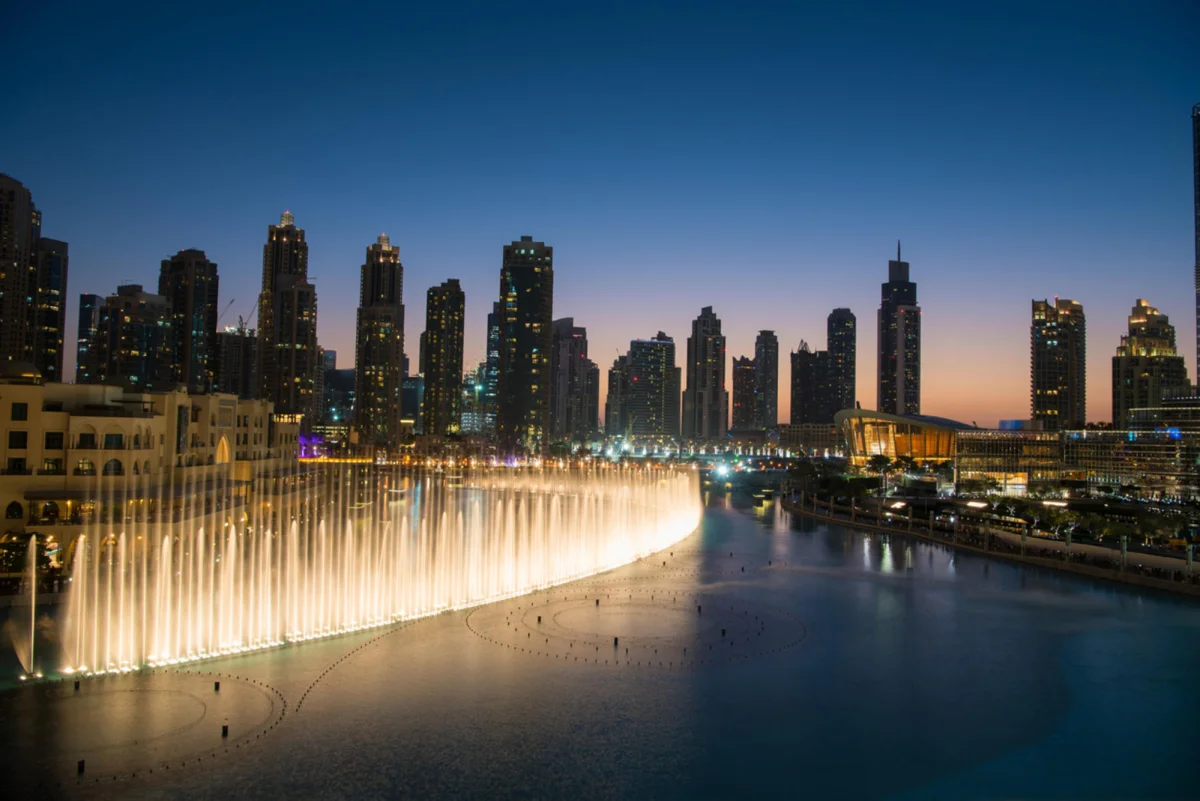
The best time to go up is an hour before sunset: you get to see the city first in daylight, then watch it light up with millions of lights. The Dubai Fountain at the base of the tower runs every evening from 6 p.m., every half hour — free and genuinely spectacular.
Dubai Mall: More Than Just a Mall
Dubai Mall is the largest shopping mall in the world by total floor area. Inside are 1,200 stores, but shopping isn't really the point. It houses an aquarium with a walk-through tunnel (10 million liters of water, rays and sharks visible even without a ticket through the glass wall), an Olympic-size ice rink, an underwater zoo, and direct access to the fountain outside.
For a first-time visitor, Dubai Mall is a reference point — people come here just to grasp the scale of the city. Spending half a day inside is easy, since beyond the shops there's air conditioning (a genuine selling point in summer) and dozens of restaurants for every budget.
Palm Jumeirah: The Island That Shouldn't Exist
This artificial palm-shaped island is a symbol of Dubai on par with the Burj Khalifa. Its "trunk" and "fronds" hold villas, hotels, and restaurants. At its tip sit the Atlantis The Royal (new, opened in 2023) and Atlantis The Palm, complete with a water park.
Walking the Palm is free: a monorail runs along the trunk (ticket: 30 dirhams), and The Pointe promenade at the island's tip is an open area with views of Atlantis and evening fountain shows.
Old Dubai: The City's Other Side
While everyone's looking up at skyscrapers, historic Dubai stays overlooked — which is a shame. The Al Fahidi district (formerly Bastakiya) is a neighborhood of 19th-century wind towers: clay walls, narrow alleys, art galleries, and cafés.
This is also home to the Dubai Museum, housed in Al Fahidi Fort (16th century) — the only genuinely old building in the entire city.
Across the creek lies Deira, home to the Gold Souk and Spice Souk. The crossing runs on a traditional abra boat for 1 dirham (roughly 25 rubles). Five minutes on the water, and you're in a world that has nothing in common with Downtown's mirrored towers.
The Desert: A Half-Day Safari
Dubai sits in the middle of the desert, and not taking advantage of that would be a missed opportunity. An evening desert safari is the single most popular excursion for first-time visitors: a 4x4 ride over the dunes, a photo stop at sunset, and dinner at a Bedouin-style camp with a live show. Prices start at 150 dirhams (roughly 3,800 rubles) per person, transfer included.
Book through local aggregators or directly with tour operators rather than through your hotel — it's cheaper. Departure is usually around 3 p.m., returning by 9 p.m. In winter, the desert cools off noticeably by evening (64–68°F / 18–20°C), so a light jacket doesn't hurt.
JBR Beach and Promenade
Jumeirah Beach Residence (JBR) is a district of beachfront skyscrapers with a pedestrian promenade, The Walk, and a beach. The beach is free, sandy, and offers loungers for rent. The Gulf water here is shallow and warm, with a gentle entry — one of the best options for families with kids.
From the JBR promenade, you can see Bluewaters Island and Ain Dubai, the world's largest observation wheel at 250 meters. One rotation takes about 40 minutes; tickets start at 130 dirhams.
How Much Dubai Actually Costs
Dubai can be both expensive and affordable — it depends entirely on your choices.
- Flights. The direct flight from Moscow takes about 5 hours. Round-trip tickets start at 25,000 rubles in low season, and 40,000 in high season. FlyDubai is a budget option — cheaper, but with no checked baggage in the base fare.
- Accommodation. A three-star hotel in the Deira district starts at 150 dirhams (roughly 3,800 rubles) a night. A five-star hotel on the Palm starts at 800 dirhams (about 20,000 rubles). Prices drop by half in summer.
- Food. A restaurant with a Burj Khalifa view runs from 300 dirhams for two. A food court meal in a mall costs 30–50 dirhams. Supermarkets are inexpensive, and cooking for yourself in an apartment rental is a viable strategy.
- Transport. The metro costs 3 to 7.5 dirhams per ride (depending on zone), and it's clean, air-conditioned, and convenient. Taxis start at 12 dirhams plus roughly 2 dirhams per km. Uber and Careem both operate here.
Visa and Formalities
Russian citizens don't need a visa — 90 days visa-free, with a passport valid for at least 6 months. The currency is the UAE dirham (AED), pegged to the dollar (1 USD ≈ 3.67 AED). Russian bank cards don't work. Cash in dollars is accepted almost everywhere, though change comes back in dirhams.
Dubai is liberal by regional standards, but modest dress (covered shoulders and knees) is expected in malls and public spaces. Swimwear is fine on the beach; going topless is prohibited. At mosques, long clothing and a headscarf for women are required (usually provided at the entrance).
Alcohol is sold only at licensed restaurants and hotel bars. Supermarkets carry it only in designated sections (restrictions eased somewhat starting in 2024). Drinking in public is not allowed.
First-Timer Mistakes to Avoid
- Booking a hotel far from the metro. Dubai is a city of distances — from JBR to the Old City is 30 km. Without a car or metro access, you're stuck within one district. Choose a hotel near a metro station and save on taxis.
- Planning walking tours in summer. At 113°F with 80% humidity, walking even 500 meters becomes a genuine test. Summer Dubai means moving from one air-conditioned space to the next. Anything you want to see outdoors should be scheduled for early morning or late evening.
- Skipping sunscreen. Even in winter, UV levels in Dubai run significantly higher than in central Russia. You can get sunburned on the beach in as little as 20 minutes.
- Not haggling at the markets. At the Gold Souk and Spice Souk, the first price quoted is just an opening offer. Bargain calmly and without hesitation — it's part of the local culture, and the seller expects it.
How Many Days to Spend There
For a first visit, 4–5 days is enough. That covers the Burj Khalifa, Dubai Mall, the Old City, the beach, a desert safari, and one evening on the Palm. Stretch it to a week if you want to add a water park, a trip to Abu Dhabi (the Sheikh Zayed Mosque is 1.5 hours by car and one of the most striking buildings in the Middle East), and a couple of unplanned days.
Dubai is a city best understood by actually being there. No photo captures the scale of it — the skyscrapers you spot from the plane twenty minutes before landing, the desert that starts right past the last building, and the sense that all of it was built in the last thirty years, in the middle of sand, heat, and nothing.
The key is landing in the right month. Because the difference between Dubai in November and Dubai in July isn't measured in degrees — it's measured in whether you can leave the hotel at all.