There are places people visit in winter despite the frost. And there are places where there's no point going without it: crystal-clear ice, the northern lights, dry Siberian snow and −50°C outside the window exist only in the cold season. We've gathered destinations where winter isn't an obstacle but the main reason to go.
A winter holiday in Russia is often seen as a compromise: the sea is far away, it's dark outside, and all that's left is a ski trip or a city with museums and cafés. But the country has plenty of places that look in winter as they look at no other time of year.
In summer, Lake Baikal is just a big lake, but in February people drive across it and gaze at methane bubbles beneath the ice. The northern lights can't be seen at all in summer: during the white nights on the Kola Peninsula, it's too light. We look at where it's worth going, and in which weeks.
Lake Baikal: Ice More Than a Metre Thick
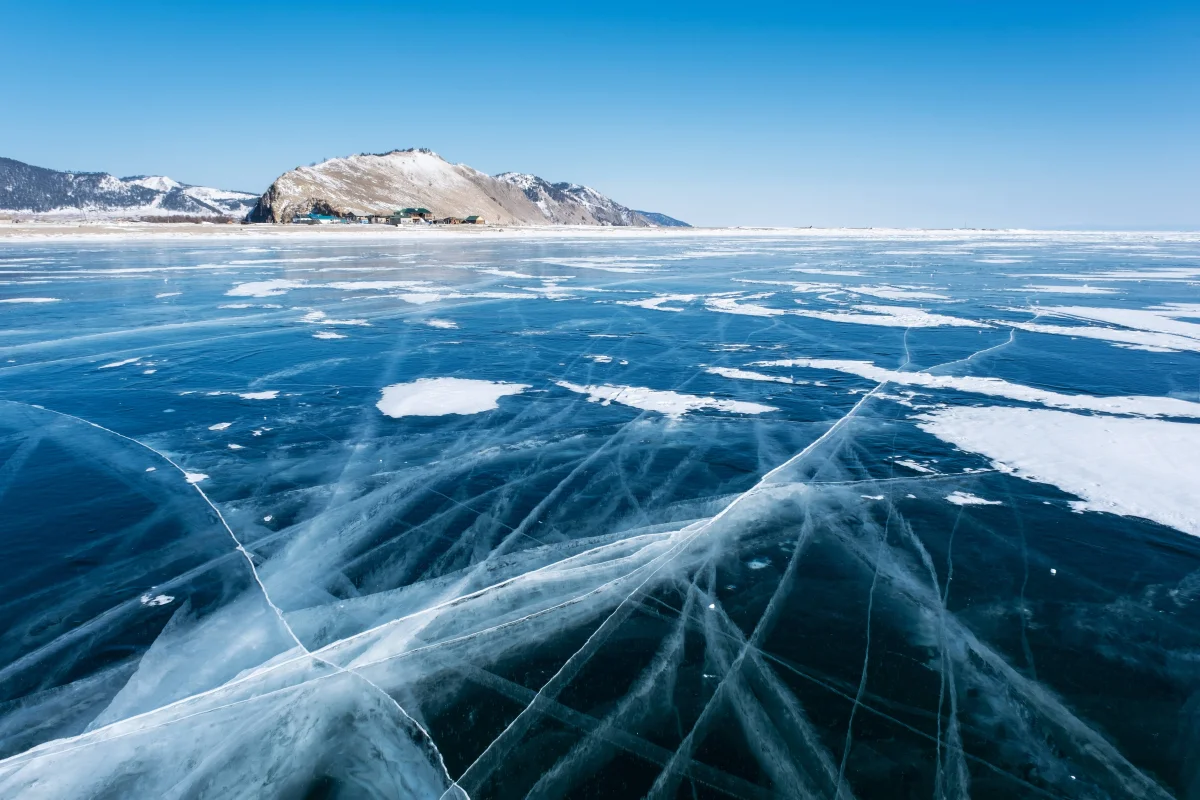
Baikal freezes in December and January, but early in the winter the ice hasn't yet hardened. The best time to go is from late January to early April, with the peak season in February and March. At this time the ice is 1.5 metres thick or more, and so clear that you can make out the underwater world through it.
What to see on Baikal in winter:
-
Methane bubbles — circles and ovals frozen into the ice, from a few millimetres to tens of centimetres across.
-
Sokui — ice splash formations up to 10 metres high, which form where waves batter a high shoreline before the lake freezes over.
-
Ice grottoes — the most beautiful are on Olkhon Island and the south-eastern shore.
-
Torosy — ridges of piled-up ice floes, which can reach 5–6 metres high by spring.
It's best to go out on the ice with a guide: ice roads for cars only open once the ice is more than 70 cm thick, and dozens of vehicles fall through the ice every year. Winter temperatures on Baikal are usually −20 to −30°C, and the wind makes them feel colder, so dress in layers; sunglasses and sunscreen are just as essential as in the mountains.
Murmansk and Teriberka: Northern Lights and Polar Night
On the Kola Peninsula, the northern lights can be seen from late August to late March, and the most active period is December to February. In Murmansk, polar night lasts from December 2 to January 11: the sun doesn't rise above the horizon. In summer, the aurora can't be seen because it's too light.
To see the northern lights, you need three things: a geomagnetic storm of at least moderate strength, a clear sky, and darkness away from city lights, at least 30–50 km from town, and ideally 100 km or more.
The most active time is roughly 10pm to 3am. But clear weather in the north isn't guaranteed: from September to March the chance of it is around 40–50%, so it's worth setting aside several nights for aurora hunting.
The main spot for chasing the northern lights is Teriberka on the Barents Sea coast, about 130 km from Murmansk. The drive takes three to three and a half hours, with the last few kilometres on a dirt road. Another option is Lovozero, 166 km from Murmansk.
The Khibiny Mountains: The Longest Ski Season
In Kirovsk, at the foot of the Khibiny Mountains, people ski from the second half of November to May, and in snowy years some runs stay open until the end of May or even early June. In the second half of December, polar night sets in, but the slopes are floodlit and skiing carries on.
The best months are March and April: long days, good snow and moderate frosts. In January, Kirovsk is usually −16 to −8°C, but the temperature can drop below −25°C, and it's always colder and windier at the top. The Khibiny bonus is that after skiing you can go and look for the northern lights: the mountains block out the glow of the town.
Sheregesh: Siberian Snow
Sheregesh in the Kemerovo Region is one of the most visited ski resorts in the country. The season runs from mid-November to late April, and the resort sometimes doesn't close until after the May holidays.
In the 2025/2026 season, it opened on November 22.
The reason people come here is the snow. In late November and early December there's so much of it that you can ski even off-piste, so the resort is a favourite with freeriders. It has more than 55 km of runs on three mountains, with a vertical drop of more than 700 metres. The nearest airport is Novokuznetsk, about two and a half hours from the resort.
Oymyakon: Frost as the Main Attraction
In Yakutia, winter is an attraction in its own right. In Oymyakon, −67.7°C was recorded on February 6, 1933, and in Verkhoyansk, the official minimum is −67.8°C. Verkhoyansk is officially recognised as the Pole of Cold, but Oymyakon trails it by just a tenth of a degree.
The head of Yakutia, Aysen Nikolaev, has described the air in Oymyakon like this: "The air is dry and sharp: every breath cuts into your lungs, and every exhalation instantly crystallises into frost."
In January, the Pole of Cold – Oymyakon marathon is held here, with distances from 5 to 50 km. In 2026, it took place on January 16–17.
Getting to Oymyakon is an adventure in itself: it's about 900 km from Yakutsk through the taiga, and you need specially prepared vehicles. That's why very few people travel here independently, and most choose organised tours. Bear in mind that the frost isn't guaranteed: in January 2026, Yakutia had an abnormal warm spell, and on the day of the marathon it was only slightly colder than −40°C in Oymyakon.
Karelia: Ruskeala in the Snow
Karelia in winter means snow-covered forests, frozen lakes and silence. The best-known spot is the Ruskeala Mountain Park with its marble canyon. From the beginning of November and throughout the winter, the canyon is illuminated in the evenings, and it looks its best after fresh snowfall on a clear, frosty evening. The Ruskeala Express heritage train runs between Sortavala and Ruskeala.
The best time is January and February: the snow has settled, and you can see the illuminations in the early evening.
Daytime temperatures here in January are usually −9 to −4°C, but the frost can drop below −20°C. The paths in the park are slippery in winter, so you'll need shoes with a good grip.
Veliky Ustyug: Winter by the Calendar
Veliky Ustyug in the Vologda Region is known as the home of Ded Moroz, Russia's Father Frost.
The main date is November 18, Ded Moroz's birthday: according to meteorologists, this is when proper winter usually arrives in the Vologda Region. On this day, the lights are switched on on the country's first New Year tree in the central square, and winter wizards from other regions gather to visit Ustyug's Ded Moroz, from Karelia's Pakkainen to Mother Winter from the Arkhangelsk Region.
This destination is above all for families with children.
Things to Consider Before a Winter Trip
- Don't cut it fine
The northern lights, clear ice and snow on the slopes all depend on the weather, so allow at least three or four days for any of these goals. One cloudy evening in Teriberka or a thaw on Baikal shouldn't ruin the whole trip.
-
Dress in layers rather than one thick coat
Thermal underwear, fleece and a windproof outer layer work better than a single down jacket. On Baikal and in the Khibiny, the main enemy is the wind, while in Yakutia it's still, dry frost.
In severe frost, phone and camera batteries die within minutes. Keep your phone in an inside pocket, and take a spare battery for photographing the northern lights or the ice.
-
Check more than just the weather forecast
For the northern lights, it's useful to follow the geomagnetic activity forecast, and on Baikal, to check information from MChS, Russia's Emergencies Ministry, on which ice crossings are open.