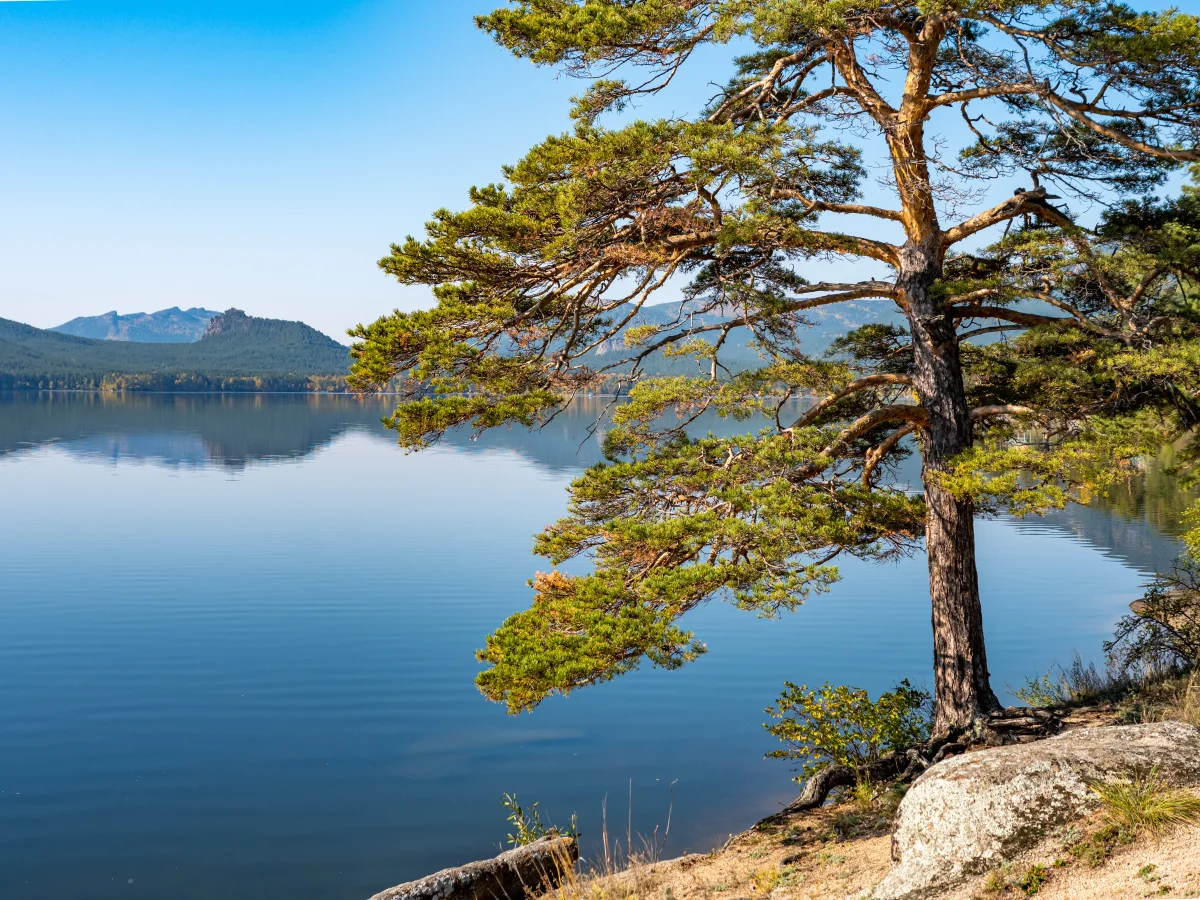
Borovoe is known as "the Switzerland of Kazakhstan": pine trees, granite cliffs and clear lakes three hours from Astana. But the swimming season here is short, lasting about two months a year. And not every lake in the area is worth the trip if you're after warm water.
Burabay, as the resort is called in Kazakhstan, isn't one lake but a whole cluster of them: there are 14 in the national park. The water in each warms up differently, even though the lakes are only a few kilometres apart. It all comes down to depth: the shallow lakes here warm up in a couple of weeks, while the deep ones hold on to the cold for almost the whole summer. We look at when to start swimming and which lake to head for first.
When the Swimming Season Begins
Borovoe has a sharply continental climate: long, frosty winters and short summers. Daytime temperatures are usually 21–27°C in June, 23–29°C in July and 20–27°C in August. The nights are cool even in summer: on July evenings it can drop below 15°C.
The water lags behind the air. In May it's too cold for most people, and often in early June too, even when the air is above 25°C. The real swimming season runs from late June to late August.
The water is at its warmest in July. Estimates vary, but at the height of summer the water temperature in Borovoe ranges from 18–21°C to 22–24°C, depending on the lake, the spot and the weather. In the second half of August the water starts to cool quickly, and in September you can only swim on warm days.
Why the Lakes Warm Up Differently
The summer sun heats the top layer of water. In a shallow lake, this warm layer quickly reaches the bottom, and all the water becomes warm. In a deep lake, a mass of cold water remains beneath the warm surface and mixes only slowly with the layer above. That's why deep lakes take longer to warm up, and in windy weather cold water from the depths can reach the shore.
In Borovoe, the difference in depth between the lakes is huge, from a couple of metres to several dozen. There are no regular temperature readings for each lake available in public sources, but depth is a good guide to where the water is warm and where it's cold.
Which Lakes Warm Up First
Lake Borovoe (Burabay) is the resort's main lake and the shallowest of the large ones. Its area is 10.5–11 km², its average depth 3.4–4.5 metres depending on the source, and its maximum depth just 7 metres. The water is clear, and you can see the bottom even in deeper spots. This is where you'll find the famous Zhumbaktas rock, known as "the Sphinx", which rises 20 metres above the water.
The shallows near the shore warm up first, so you can swim here earlier than in the deeper neighbouring lakes.
Lake Maloye Chebachye is an elongated lake up to 13.6 km long, with an area of about 17 km². Its average depth is 4.7 metres and its maximum 15.5 metres. The water is slightly brackish. It warms up more slowly than Borovoe, but noticeably faster than the large, deep lakes nearby.
Lake Shchuchye is one of the resort's deepest lakes, with the town of Shchuchinsk on its shore. Its area is about 18.5 km² and its average depth about 5.3 metres, while estimates of its maximum depth range from 30 to 40 metres. Because of its deep sections, Shchuchye warms up slowly and is considered one of the coldest lakes for swimming. On the other hand, it has plenty of private and public beaches, and holidays here are usually cheaper than at Borovoe.
Lake Bolshoye Chebachye is the largest lake in the area, at about 25.5 km². Its average depth is more than 10 metres, and its maximum 33 metres. By average depth, it's the deepest of Burabay's large lakes, so the water here probably takes longest to warm up. The shores are picturesque, with sand, pebbles, granite boulders and several islands.
Lake Kotyrkol, 12 km from Borovoe, is shallower still, with an average depth of about 2.5 metres. Lakes like this warm up very quickly, but the water here is brackish.
Why the Water Is So Clear, and So Cold
Burabay's lakes are fed not only by streams and precipitation but also by groundwater, which collects in cracks in the granite and seeps downwards. That's where both the clarity Borovoe is prized for and the cool water come from.
But the lakes also have a problem: they're gradually shrinking. "The area of the water surface and the shoreline are decreasing," says Yevgeny Arkhipov, a senior researcher at the Burabay National Park.
According to the park's hydrogeologist, Galina Pyatova, the process is influenced by precipitation and the levels of meltwater, groundwater and surface water. In some years, though, the level rises: in 2024, after heavy rainfall, Lake Borovoe rose by about 80 cm, and its water overflowed through the Gromotukha river into Lake Bolshoye Chebachye.
What It Costs and How to Get There
Entry to the national park is charged for each day of your stay, at a rate tied to Kazakhstan's monthly calculation index, a reference unit used to set fees and fines. In 2026, from May to September, the fee for a car is 1,298 tenge (about $2.90) a day on weekdays and 1,730 tenge (about $3.90) at weekends and on public holidays.
Accommodation in summer: budget rooms and cabins cost 15,000–25,000 tenge a night ($33–56), family holiday centres and three-star hotels 35,000–60,000 tenge ($78–134), and premium hotels 90,000–140,000 tenge ($200–310) and up.
Borovoe is about 250 km from Astana: two and a half to three hours by car on a toll road. The Burabay Express train takes about two and a half hours, with third-class tickets from 2,962 tenge (about $7). A regular train to Kurort Borovoe station takes three to four hours, and a berth in an open-plan sleeper car costs around 4,000 tenge (about $9).
Russians don't need a visa: you can even enter with a Russian internal passport and stay for up to 90 days within six months. As citizens of the Eurasian Economic Union, Russians are exempt from registration for the first 30 days; if you're staying longer, your hotel or landlord arranges the registration.
Direct flights from Russia go to Astana, and from there you continue by train or car. Russian Visa and Mastercard cards don't work in Kazakhstan, and Mir cards are hardly accepted anywhere, so it's worth getting hold of some tenge in advance.
How to Plan Your Trip
-
Going in late June? Choose Lake Borovoe. It warms up first, and by then the shallows near the shore are already quite comfortable. Shchuchye and Bolshoye Chebachye can be noticeably colder in early summer.
-
Going in July? Any lake will do. It's the warmest time for swimming, but also the busiest, so book accommodation near Borovoe in advance.
-
Going in late August? Stick to the shallow lakes again and don't count on long swims: the water cools quickly, and the evenings already have an autumn chill.
Whatever the month, bring a warm jumper: even in the July heat, the nights in Borovoe are cool, and by evening there's a breeze off the water too.