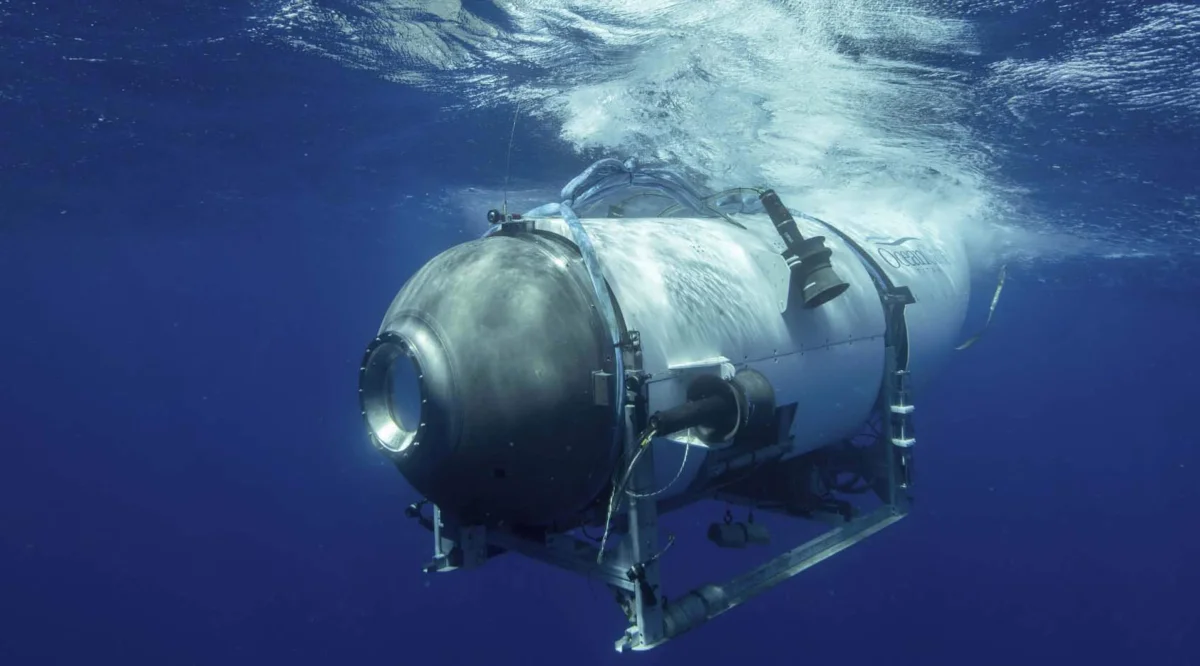
Let us recall that the submersible «Titan» was heading for the wreckage of the famous liner «Titanic» in the northern part of the Atlantic Ocean. It was supposed to descend to a depth of almost 4,000 kilometers. But on June 18, the vessel's crew and passengers stopped making contact. There were five people on board: the founder of OceanGate, a company that runs excursion dives to the «Titanic», Stockton Rush; French researcher Paul-Henri Nargeolet; English billionaire Hamish Harding; and Pakistani billionaire Shahzada Dawood with his 19-year-old son Suleman.
All available resources were thrown into rescuing the submersible. According to experts, only a few hours of oxygen remained, and many already understood at that point that all rescue attempts were doomed to fail. The teams simply would not make it to the crew in time, and the people would suffocate. Only five days later, on June 23, was the first wreckage of the submersible discovered. Experts acknowledged that the people had probably died almost immediately after the dive. Due to the pressure, the submersible imploded and was crushed like a tin can. On June 28, the underwater teams began raising the remaining wreckage of the vessel, along with the discovered human remains, which still have to be identified.
While the investigation into the causes of the submersible's loss is underway, various experts are putting forward their theories and versions.
Version 1. A faulty hatch
.jpg)
British expert Ryan Ramsey, a Royal Navy submarine captain, allows that the cause of the explosion could have been the hatch, secured by only 17 bolts.
«The hatch with 17 bolts, used for sealing, may have failed, which then led to the destruction of the hull under enormous pressure».
Version 2. Defects in the hull of the vessel
Another possible explanation, in Mr. Ramsey's opinion, is that the pressure hull itself had a pre-existing defect. It went unnoticed, or there was simply negligence and it was ignored. And then this defect began to crack and break down under pressure, which led to the explosion.
Version 3. An internal explosion
And this too could have been influenced by defects and microscopic cracks in the hull.
«Clearly, something compromised the integrity of the hull. An implosion of the underwater vessel occurred, that is, an inward explosion. The pressure compressed the submersible so much that, roughly speaking, it simply burst on the inside, like a balloon», – stated William Kohnen, chairman of the Manned Underwater Vehicles Committee.
Version 4. Hull material unsuitable for deep-sea dives

Experts point out that the submersible «Titan» was, after all, not a professional vessel but an expedition craft for excursions. And perhaps during construction shortcomings and errors were made. And frequent dives led to the hull's rapid wear.
For example, former Marine Robert Mester admitted that he had once declined an excursion with OceanGate precisely because of such doubts. Mester is a professional in the field of deep-sea rescue work and possesses knowledge of operating in difficult underwater conditions. He believes that the equipment and materials used are not suitable for the depths the crew intended to reach in the submersible «Titan».
«None of the equipment I saw inside the submersible met the required standard. So I simply declined the excursion», – says Mester.
The Titan submersible will be reassembled from its wreckage – to understand what happened