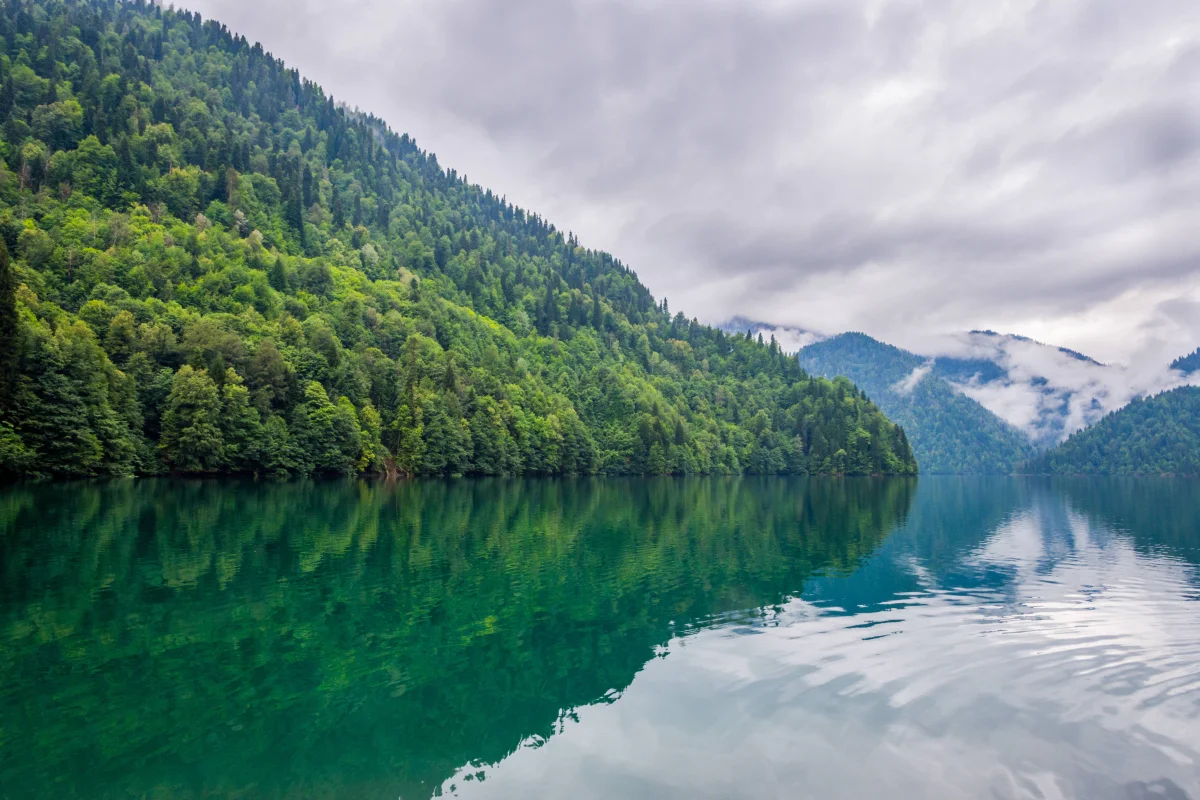
The water in Lake Ritsa looks turquoise and calm, and after three hours of hairpin bends in the heat you'll be desperate to get in. But swimming here is banned, and the ban is no mere formality.
A typical trip to Ritsa goes like this. By morning it's already 30°C on the coast at Gagra, the tour bus winds its way up the gorge, then a lake the colour of seawater opens up ahead, surrounded by mountains cloaked in fir forest. The shore is pebbly, the water clear, and someone always takes off their shoes to wade in "just up to the knees". That's usually when the guides start talking them out of it. This lake has several features that make it one of the most treacherous bodies of water in Abkhazia.
What Kind of Lake Is It?
Ritsa lies at an altitude of 950 metres above sea level, in the Ritsa Relict National Park. By geological standards it's a young lake: estimates of its age range from a few hundred years to about a thousand. It formed when part of Mount Pshegishkha collapsed into the valley and dammed the Lashipse River.
Several rivers and streams flow into the lake, but only one flows out: Yupshara.
Ritsa is modest in size: about 2.5 km long, up to a kilometre wide, with an area of about 1.5 km². But it's very deep. Its greatest depth is 116 metres, while its average depth is about 63 metres. That's roughly the height of a 38-storey building.
How Cold Is the Water?
Even at the height of summer, the water in Ritsa warms up very little. The surface of the lake is above 10°C only from late June to October, and it peaks in August at around 17.6°C.
Crucially, that's the temperature of the top layer. Further down, the water is much colder, and mountain rivers carry meltwater from snowfields into the lake. So even in August, when the coast is baking, the water in Ritsa feels searingly cold after the sun.
Back in 2015, Roman Dbar, director of the Institute of Ecology at the Abkhaz Academy of Sciences, explained that this is the main danger: "It can lead to cardiac arrest and a stop in breathing."
After that, he said, it's a matter of moments: "Literally a few seconds are enough for a person who has lost consciousness to choke and die."
The Depth Starts Right at the Shore
On a sea beach, people are used to wading in gradually: first ankle-deep, then waist-deep. That doesn't work at Ritsa. The lake's underwater slopes are very steep, and great depths begin almost immediately at the water's edge.
That means that if your leg cramps or you're left gasping for breath, you probably won't be able to stand on the bottom. Swim a few metres out to take a photo, and there are already dozens of metres of icy water beneath you.
Currents You Can't See
The surface of Ritsa is usually smooth, and it seems as though nothing is moving. But the mountain river Lashipse flows into the lake, and its flow creates a strong underwater current.
In 2021, Abkhazia's emergencies ministry specifically warned about the current, the complex terrain of the lake bed and the low water temperature, as well as the fact that the bottom of the lake has been poorly surveyed. The ministry's wording was blunt: "Swimming in Lake Ritsa is strictly prohibited and fraught with tragic consequences."
There's one more reason, which Roman Dbar has mentioned: the lake bed is covered in several layers of fir and spruce trunks, from trees that grew in the valley before the landslide, as well as silt. If something happens to a swimmer, searching for them in such water is very difficult, even for divers.
What the Rules Say
Swimming is banned both in Ritsa and in the other lakes of the national park. The park administration cites environmental protection legislation and the regulations governing the national park: all the lakes lie within a protected area.
In practice, park staff usually just warn visitors and put up no-swimming signs. That's why many people take the ban lightly, and they shouldn't: it's not about the punishment, it's about the risks.
The ban has an environmental side too. Mass bathing, sunscreen and cosmetics harm the fragile ecosystem of a mountain lake. And in Abkhazia, mountain rivers and lakes are traditionally regarded as sacred, so local people see swimming in them as disrespectful.
What About Blue Lake?
On the way to Ritsa, tours almost always stop at Blue Lake at the 15th kilometre of the Ritsa road. It's tiny, about 20 metres across, but the water is such a colour that many people are tempted to take a dip.
Its depth has never been measured precisely: estimates range from 49 to 76 metres. In summer, the water here never warms above 10°C, and swimming in Blue Lake is also banned: you can only splash your face.
How to Visit Ritsa Without Unnecessary Risk
-
Choose your timing
The best periods are late spring, early summer and autumn, when it isn't too hot and there are fewer tourists. From December to April, the national park may close because of snowfall and avalanche risk, so if you're planning a winter trip, check in advance.
-
Bring warm clothes
The lake lies at almost a kilometre above sea level, and even when Gagra is sweltering, it's cool by the water, especially in the morning and evening. A windproof jacket in your backpack will come in handy.
-
Set aside a whole day
It's about 55 km from Gagra to the lake, about 110 km from Sukhumi, and the last 25 km is along a mountain road inside the park. With stops, the journey takes about 3 hours each way. There's no public transport into the park: you'll need your own car, a hire car or a tour.
An environmental fee is charged at the park entrance: from May 1, 2026, it's 1,000 roubles for adults and 500 roubles for children aged 8–12, while children under eight get in free.
-
Save swimming for the sea
If you really want a dip, it's better to head back to the coast by evening: in August, the Black Sea off Abkhazia warms up to comfortable temperatures. At Ritsa, stick to a walk along the shore and taking photos. And before you go down to the water "just up to your ankles", remember: the depth here starts almost immediately.