A hailstone 5 centimeters in diameter forms inside a cloud where updrafts reach speeds of 250 km/h — stronger than a category-five hurricane. Holding a chunk of ice the size of a chicken egg aloft takes energy that seems almost excessive for nature to produce. Yet clouds like this form over Russia every summer — and not all that rarely.
Hail is a strictly seasonal phenomenon: it's tied to powerful thunderstorms that occur only during intense surface heating. Winter hail is nearly impossible, spring and autumn hail is rare, and the peak falls during the hottest months, when updrafts are strong enough to toss ice pellets into the stratosphere again and again.
When It Falls Most Often
In the mid-latitudes — which covers most of European Russia — hail season runs from May through August, with an absolute peak in June–July. It's during these two months that every necessary condition aligns: a hot surface, humid air, and atmospheric instability.
But Russia is vast, and the hail calendar varies by region.
The North Caucasus — the country's most hail-prone territory — sees its season start as early as April and stretch through September. Krasnodar and Stavropol krais, Kabardino-Balkaria, and North Ossetia get hit by large hail dozens of times each summer. The mountains act as a catalyst: humid air climbs the slopes, cools rapidly, and forms powerful storm cells.
In central Russia (Moscow, the Moscow region, the Black Earth region), hail is less frequent but regular — 5 to 10 times per summer. Usually it's small pea-sized pellets, but once every few years, storms bring hail 2–4 centimeters across — enough to dent cars and shatter greenhouses.
In Siberia, the peak shifts to July: the ground warms later, and thunderstorm activity peaks midsummer.
In June 2024, Novosibirsk endured lemon-sized hail — stones punched through balcony canopies.
In the north (Murmansk, Arkhangelsk, Komi), large hail is exotic. The air never warms enough to spin up powerful updrafts.
How Hail Forms — and Why Wind Speed Determines Size
The mechanism starts with a water droplet that an updraft carries to an altitude of 7–10 kilometers, where the temperature is –30 to –40°C. The droplet freezes into an ice pellet. If that were the end of it, the pellet would fall as fine grains and harm no one.
But the updraft doesn't let go. It catches the pellet and hurls it back to the upper part of the cloud, where a new layer of water freezes onto it. The pellet grows heavier, begins falling — and gets caught by the updraft again. Each cycle adds a layer, and the hailstone grows like an onion — layer by layer, in concentric rings.
The number of cycles determines the size. Two or three ascents produce a pea. Five to seven produce a walnut. Ten or more produce a chicken egg or larger.
"To create a hailstone larger than a centimeter in diameter, updraft speeds must exceed 20 meters per second. Hailstones larger than 5 centimeters only form in supercell cumulonimbus clouds, where updrafts can reach speeds of around 250 meters per second," explains Natalia Cheredko, senior researcher at the Institute of Monitoring of Climatic and Ecological Systems of the Siberian Branch of the Russian Academy of Sciences.
The Size Scale: From Peas to Grapefruit
Meteorologists classify hail by diameter, and each step up represents a multiplied increase in destructive power.
- Under 1 cm (pea). Harmless to people and buildings. Clatters on the roof, startles you, but causes no damage. The most common type — around 80% of all cases.
- 1–2 cm (cherry). Can shred plant leaves and flowers, but cars and buildings hold up fine.
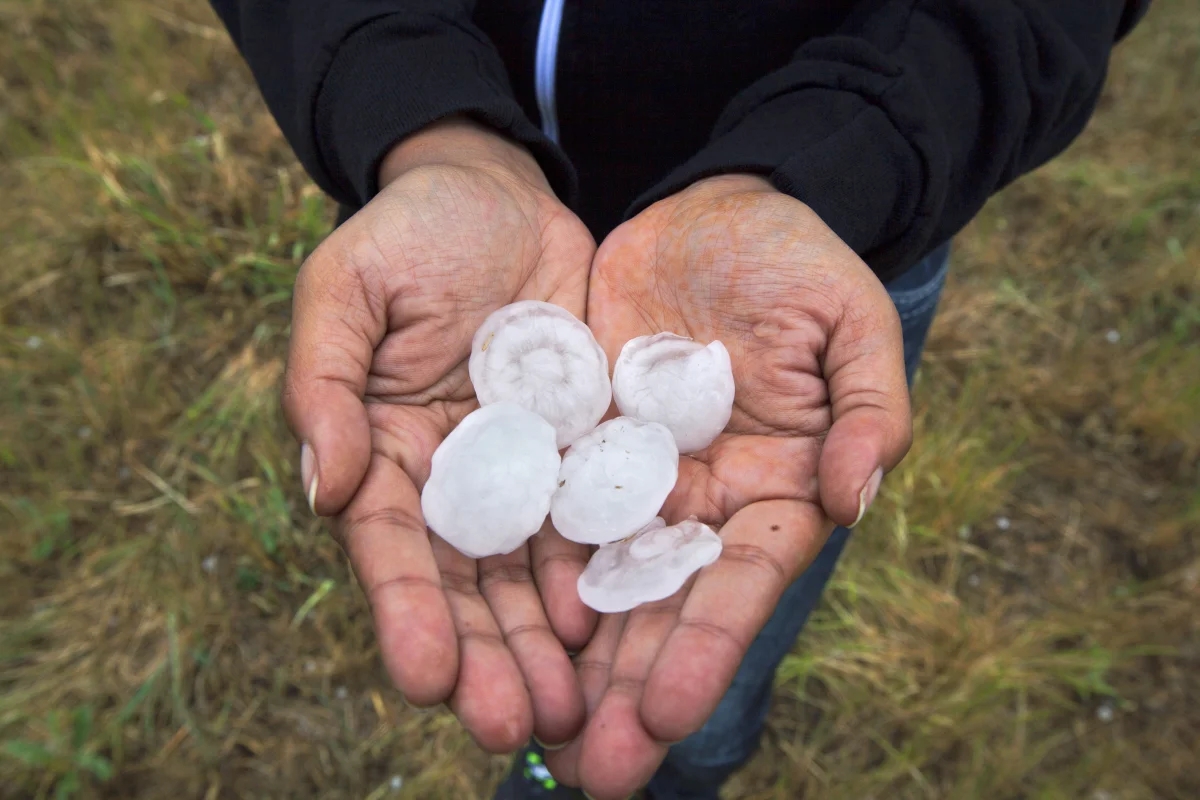
- 2–4 cm (walnut). Damage zone begins: dented car bodies, shattered greenhouse glass, wrecked crops. This is the size regularly recorded in Krasnodar Krai and the Moscow region.
- 4–6 cm (chicken egg). Serious destruction: shattered windshields, punctured roofing sheets, human injuries. Hailstones weigh 30–50 grams and fall at speeds up to 100 km/h.
- Over 6 cm (tennis ball and larger). Catastrophic hail. Punches through roofs, deforms metal, kills livestock. A person caught without shelter is in mortal danger.
The all-time record: a hailstone 20 centimeters in diameter, weighing 880 grams, recorded in South Dakota, USA, in 2010. And even without breaking records — in Bangladesh in 1986, one-kilogram hailstones killed 92 people in a single storm.
Why One Storm Brings Peas and Another Brings Eggs
Two storms passing over the same city on the same day can produce fundamentally different hail. The reason lies in the type of storm cell.
- An ordinary (single-cell) storm lasts 30–60 minutes, with updrafts of 10–15 m/s. Hailstones manage only one or two cycles and fall small. Most summer storms — loud but harmless — fall into this category.
- A multicellular cluster consists of several cells feeding off one another. Updrafts reach up to 25–30 m/s. Hailstones grow larger — up to 2–3 centimeters. Storms like these move through in bands and can carpet a strip of land several kilometers wide with hail.
- A supercell is a standalone, powerful, long-lived storm with a rotating updraft (mesocyclone). Updraft speeds reach 50–70 m/s and beyond. Hailstones cycle repeatedly and grow to apple-sized or larger.
Supercells are rare in Russia, but the North Caucasus, the Volga region, and Western Siberia see several each season.
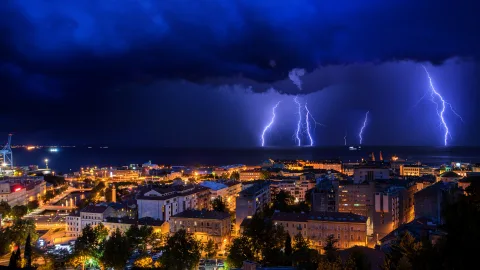
Another factor is a link to lightning. Research shows that the more powerful the lightning within a cloud, the larger the hail that forms. There's a theory that electrical discharges promote the merging of small hailstones into larger ones — but the mechanism isn't fully understood yet.
How Russia Fights Hail
The North Caucasus operates one of the largest hail-suppression systems in the world, running since Soviet times. The principle: rockets or artillery shells loaded with silver iodide are fired into storm clouds, creating thousands of artificial crystallization centers.
Instead of all the supercooled water freezing onto a handful of large hailstones, it gets distributed across millions of tiny ones — which either melt before reaching the ground or fall as harmless granules. Effectiveness reaches up to 80% damage reduction, according to Roshydromet.
Hail-suppression services operate in Krasnodar and Stavropol krais, Kabardino-Balkaria, North Ossetia, and Dagestan — regions where agricultural hail damage runs into billions.
When the Risk Is Lowest
The safest time is winter and early spring. At subzero surface temperatures, updrafts are too weak to form hail-bearing clouds. Snow, rain, blizzards — sure. Hail — practically impossible.
In autumn (October–November), hail is also extremely rare: the sun sits low, and surface heating is minimal. Autumn storms do occur, but without the power needed for large hail.
Even within summer, a pattern holds: hail falls most often in the afternoon — between 2 and 7 p.m., when surface heating peaks. Morning hail is exotic. Nighttime hail is nearly impossible (the ground has cooled, updrafts have weakened).
If a storm builds by midday and clouds tower vertically, the probability of hail rises sharply.
What to Do If the Forecast Warns of Large Hail
EMERCOM and Roshydromet issue hail warnings as part of storm alerts — usually hours in advance. If a warning arrives:
- Get your car under cover or into a garage. Large hail can turn a car body into a lunar landscape in five minutes.
- Remove anything from outdoors that could be damaged: flower pots, strollers, furniture.
- Close windows and shutters. A walnut-sized hailstone can shatter ordinary glass.
- Don't go outside during hail. A 3–4 centimeter hailstone striking the head can cause traumatic brain injury.
- If caught outdoors, take shelter in any building. If no building is nearby, crouch down and cover your head with your arms, a bag, or a jacket.
Hail typically lasts 5–15 minutes, rarely up to half an hour. Waiting it out isn't difficult. But in those few minutes, it can cause damage that takes months to repair.