Most tourists come to Baikal in summer — and see one lake. Those who return in winter see an entirely different one. In autumn, a third. Baikal transforms beyond recognition four times a year, and each version is worth a separate trip.
Baikal isn't a resort with a single season. There's no such thing as "the best time to visit" — there are different formats of travel, each tied to its own month. Summer Baikal and winter Baikal are two different places, connected only by coordinates on a map.
Winter: Ice Like Nowhere Else on Earth
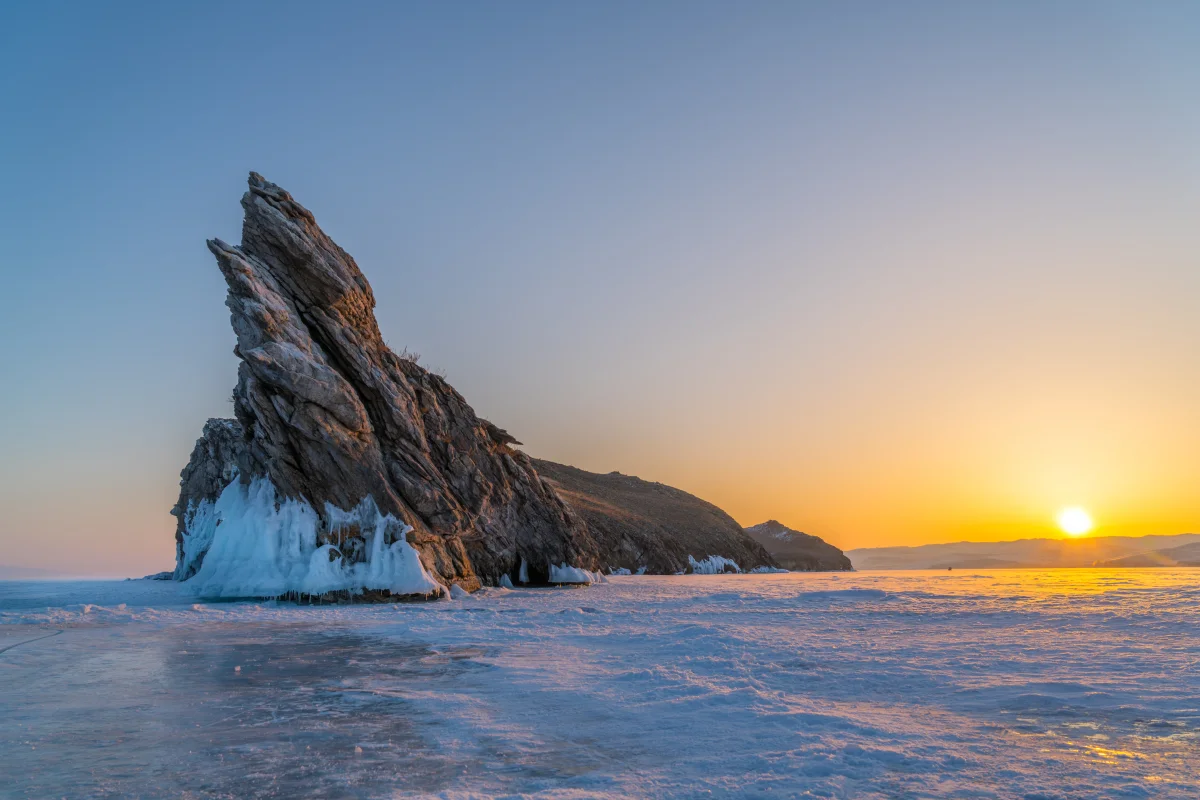
February and March are the winter peak, and for many travelers this becomes the defining experience. By February, the lake freezes over completely — 31,500 square kilometers become the largest natural ice rink on the planet, comparable in area to Belgium.
Baikal's ice is unlike any other. It's so transparent that through a meter-thick layer you can see the bottom in shallow areas. Frozen inside the ice are bubbles of methane rising from the lakebed — "pearl strings" that photographers travel from around the world to capture.
Pressure ridges — jagged piles of ice blocks — rise several meters high. On the cliffs of Olkhon, turquoise ice grottoes form along the rock face.
In February, daytime temperatures range from –10 to –20°C, dropping to –30°C at night. March brings warmer days, bright sun, and ice that's still solid. March is considered the most comfortable winter month: you can walk across the ice in sunglasses and a light down jacket.
What's available in winter:
- Ice crossings to Olkhon Island — replacing the summer ferry.
- Rides on hovercraft and UAZ vehicles across the ice.
- Ice caves and grottoes at Cape Khoboy.
- Watching nerpa — Baikal's freshwater seals crawling onto the ice to sun themselves.
- Ice fishing for omul, grayling, and whitefish.
Summer: Swimming, Rafting, and Hiking
July and August are the classic season. Air temperature hits +20–28°C, and in the shallow bays of the Little Sea and Chivyrkuy Bay, water warms to +20–24°C. This is the only time you can properly swim in Baikal — a window lasting four to six weeks.
Summer is the season for hiking. The Great Baikal Trail runs along the shoreline, revealing bays, headlands, and taiga landscapes. River rafting on the Selenga, Snezhnaya, and Utulik ranges from gentle family floats to serious whitewater. Excursions along the Circum-Baikal Railway — an early 20th-century engineering marvel with dozens of tunnels and viaducts.
Summer's downsides: crowds and mosquitoes. Olkhon in July–August is overrun with tourists, prices peak, and biting insects in the coastal taiga stay active through mid-August. Repellent and a head net aren't precautions — they're a necessity.
Autumn: Gold, Silence, and the Perfect Light
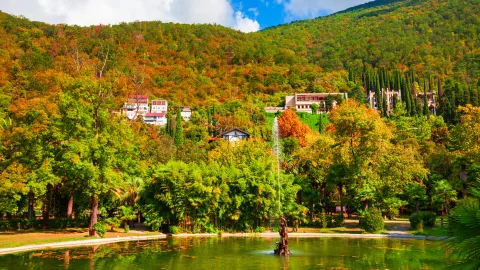
September is the most underrated month. The tourists have left, the mosquitoes have vanished, and the taiga blazes in gold and crimson. The air is crystal clear, visibility at its maximum — the far shore, 40 kilometers away, is visible as if you could reach out and touch it.
Temperature sits at +8–15°C during the day; nights are already cold, dropping to 0°C and below. Swimming is off the table, but for photography, trekking, and contemplation, it's perfection. Lodges offer discounts, roads are clear, and on the trails — not a soul.
October is harsher. Winds intensify, and the sarma — a squall that crashes down from the mountains onto the lake — reaches its peak frequency. Beautiful, but punishing. For the prepared.
Spring: Ice Breakup and Awakening
April and May are the transition. The ice begins to shatter: cracks appear, along with overflow patches and open leads. Walking on the ice is now dangerous, but the spectacle itself — Baikal's ice breakup — is staggering. Enormous floes grind against each other with a roar as the lake "breathes" and sets itself free.
By late May, the ice is gone, but the water is still frigid — +4–6°C. Trees begin to leaf out while snow still clings to the mountain slopes. The contrast is spring and winter in a single frame.
May suits those who want to see Baikal with absolutely no one around: neither summer tourists nor winter ones. Not all infrastructure is running, but the basics — accommodation, transport, food — are available.
Where to Base Yourself
Your entry point depends on the season and the route:
- Listvyanka — the nearest village to Irkutsk on the lakeshore (70 km). Convenient for a first introduction, but not for an extended stay — small and touristy.
- Olkhon Island — the heart of Baikal. Accessed by ferry in summer, ice crossing in winter. Cape Burkhan (Shaman Rock) is one of the lake's most iconic landmarks. Infrastructure is basic but sufficient.
- Slyudyanka and Baikalsk — the southern shore. Starting point for routes to Chersky Peak and the Khakusy hot springs.
- Maksimikha and Ust-Barguzin — the eastern shore. Chivyrkuy Bay, the hot springs of Zmeinaya Bay. Less hyped, quieter, cheaper.
Which Season for Which Format
First time at Baikal — August. The most predictable window: warm weather, everything operational, swimming possible. Already been in summer and want a different Baikal — February–March. The ice will completely redefine the lake for you. Love silence and photography — September. Golden taiga, empty shores, transparent air.
Ready for something extreme — April. Ice breakup, nobody around, the feeling of standing at the edge of the world.
There truly is no wrong answer — just different Baikals. And every one of them is worth flying halfway across the country to see.