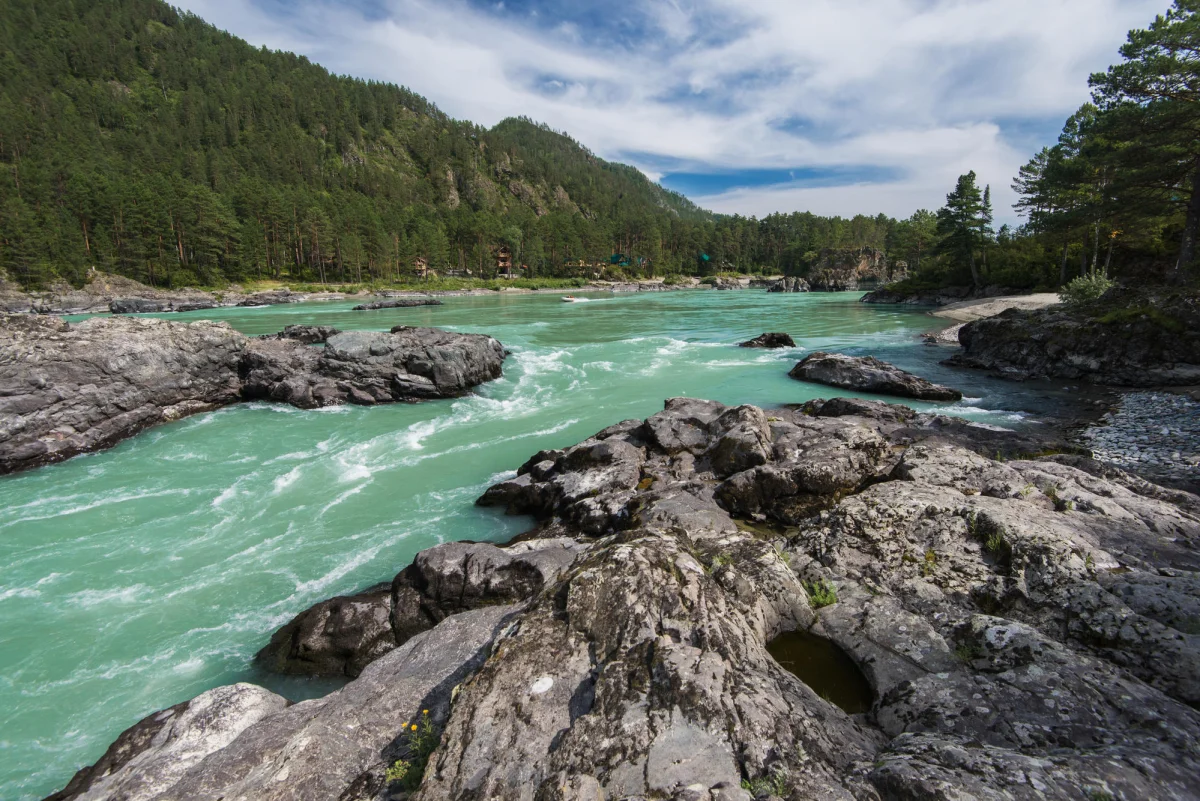
In summer, the Katun River runs murky and gray, like watered-down milk. Then, within a couple of weeks, it's as if someone swapped the river out entirely: the water turns clear and takes on a vivid turquoise that no photo editor could recreate.
Tourists visiting Altai for the first time in August scroll through other people's autumn photos and refuse to believe it's the same river. The grayish-white current they're walking alongside has nothing in common with the bright turquoise water in those shots. But come back a month later, and the Katun genuinely will be different. Let's break down why this happens, and when to catch it.
Where the Murky Summer Water Comes From
The Katun originates at the Gebler Glacier on the southern slope of Mount Belukha and flows nearly 700 kilometers across the whole of Gorny Altai. Along the way, dozens of tributaries feed into it, many carrying water straight off glaciers.
In spring and summer, when glaciers melt actively, the Katun's water becomes saturated with microscopic particles of ground-up rock — so-called glacial flour.
This is a microscopic suspension that the glacier grinds off the bedrock beneath it. The particles are so fine they never settle to the bottom — they stay suspended in the current, giving the water its characteristic murky, milky-gray color. Locals call this "ice milk."
What Happens in Autumn
By September, mountain nights turn cold, and glaciers stop melting actively. The inflow of meltwater drops sharply. Rainfall tapers off too. The river's main source shifts to groundwater — by various estimates, groundwater accounts for up to 80% of flow in autumn and winter.
Groundwater passes through layers of rock and gets naturally filtered along the way. It carries no glacial sediment — it's clean and clear. As soon as the share of meltwater in the river drops, the murkiness disappears, and within just one or two weeks, the Katun transforms from gray to turquoise.
Why Turquoise Specifically, Not Just Clear
Clear water on its own is colorless. The Katun's turquoise hue comes from a combination of two factors.
The first is greenstone sandstone, which the river carves its channel through along its middle and upper reaches. Once the water clears of sediment, the riverbed becomes visible — composed of rock with a greenish-gray tint. The reflection off that riverbed is what gives the water its distinctive color.
The second is the refraction and scattering of light in clear water. In autumn and winter, the sun sits lower in the sky, changing the angle at which light hits the water, and the turquoise hue becomes especially saturated. Essentially, this is an optical effect — the same principle at work in mountain lakes with rocky bottoms.
When Exactly to Catch the Turquoise Water
There's no fixed date — it all depends on when the glaciers stop melting and how much rain falls at the end of summer. But here's a general guide:
- Late August — the Katun starts lightening, with turquoise beginning to show through, though still tentative. A heavy rain can turn the water murky again for a day or two.
- September — the main month of transformation. By mid-September, most stretches of the river are already distinctly turquoise.
- October — peak vividness. The water reaches maximum clarity, and the golden larch foliage lining the banks creates exactly the contrast that makes photos of the Katun instantly recognizable.
- November–March — the turquoise color persists through winter on stretches that don't freeze over. Winter offers the clearest water of the entire year, though reaching the most scenic spots becomes harder.
- April–May — meltwater season begins, murkiness returns, and the turquoise disappears until the following autumn.
Where the Color Is Most Visible
Not the entire Katun turns equally turquoise. Further downstream, after the murky Chuya River joins it, the color fades noticeably — the tributary's grayish-brown water mixes into the main channel and dilutes the hue. The best viewing spots sit along the middle stretch, upstream of the Chuya confluence:
- The confluence of the Katun and Chuya near the village of Chuy-Oozy — two streams of contrasting color flow side by side without mixing for several kilometers. In autumn, the contrast between the turquoise and murky gray is especially sharp.
- The stretch from Chemal to Manzherok — here the river runs wide and calm, with gently sloped banks offering easy access to the water.
- The Blue Lakes ("the Eyes of the Katun") — these form within the riverbed in autumn and winter, once water levels drop. Two or three non-freezing pools, up to 8 meters deep, with vivid turquoise water. In summer, they simply don't exist — spring floodwaters submerge them entirely.
What to Consider When Planning a Trip
The ideal window for anyone specifically chasing the turquoise Katun is the second half of September through the first half of October. By this point, the river has reliably changed color, the weather still allows for comfortable walking (41–59°F / 5–15°C during the day), and golden autumn in the valley adds something winter photos simply don't have.
Nights turn cold during this window — as low as 23°F (–5°C) in October — so anyone planning to camp will need a winter-rated sleeping bag.
Roads along the Chuysky Tract stay open year-round, but after the first snowfalls, the side dirt roads leading to specific viewpoints can become difficult to navigate. The closer to November, the higher your odds of catching both the turquoise water and snow along the banks — but the shorter the daylight hours, and the fewer options for overnight stays.